
Anyone studying election integrity knows there is no single, silver-bullet solution to those attempting to manipulate election outcomes; i.e. politicians, bureaucrats, and activist groups that quietly alter administrative details, thereby intentionally leaving voting systems vulnerable to corruption. The cure for this attempted death-by-a-thousand-cuts is a thousand strategically placed band-aids; small, targeted changes that incrementally fortify election security.
That is precisely what the Department of War did in a recent request to update the wording on the Federal Post Card Application, the standard form used overseas to register to vote and request an absentee ballot. The Trump Administration recently changed the form used by overseas military voters to prevent thousands of voters who’ve never lived in the United States from improperly casting ballots in America’s elections.
This was necessary because (1) Democrats insist that non-citizens get to vote and count toward congressional apportionment, actively soliciting every “available voter” around the world, and (2) the Uniformed and Overseas Citizens Absentee Voting Act (1986) allows absentee voting by members of the U.S. military, the Merchant Marine, their eligible family members, and U.S. citizens residing outside the United States.
Incredibly – and separate from the core intent of UOCAVA – individuals who’ve never lived in the United States, and who never intend to, are currently permitted to vote in U.S. elections if at least one parent was born in the United States. Known as “never-resided” voters, these individuals are eligible to cast absentee ballots in 32 states and the District of Columbia.
While written rules for mail-in registration generally exclude never-resided individuals, a paperwork change years ago allowed them easy access to our elections through the FPCA, which is readily downloadable online. That form included a specific checkbox for never-resided voters that read: “I am a U.S. citizen living outside the country. I have never lived in the United States.” That single line served as an open invitation for never-resided individuals to vote under UOCAVA.
The new form ditches that line entirely and requires applicants to state whether they possess a valid driver’s license and provide the number. In the absence of state-issued identification, applicants must provide the last four digits of their Social Security number. Anyone lacking that information will be contacted by their local election office for further identity verification.
Consequently, never-resided voters can no longer use this federal form—nor should they ever have been allowed to. The previous form failed to comply with the 2002 Help America Vote Act, which explicitly states that an application for voter registration for a federal election may not be accepted or processed by a state without either the applicant’s current, valid driver’s license number or the last four digits of their Social Security number.
The new form also halts attempts by states like Pennsylvania to issue ballots prior to verifying applicant eligibility. This is a critical fix, considering that in 2022, the Pennsylvania Department of State instructed county election officials to send ballots to unverified voter registration applicants and subsequently went to court to defend that directive.
In past election cycles, when results were announced on election night, officials routinely noted that a small batch of “military ballots” remained to be counted. Observers would quickly calculate whether that handful of military ballots could realistically bridge the margin between candidates. Usually, they could not. Today, however, officials refer to these simply as “overseas ballots,” reflecting the fact that military members no longer constitute the majority of this voting block.
Leftist activists have established self-described “nonpartisan” NGOs—such as the Center for U.S. Voters Abroad Turnout Project, and VoteFromAbroad.org,—which are interconnected, Democrat-leaning, and focused primarily on aggressive overseas voter registration drives.
The Biden administration joined this effort, channeling substantial taxpayer funding through the Federal Voting Assistance Program (FVAP) to advertise to never-resided U.S. citizens that they were eligible to participate in domestic elections. A review of social media accounts managed by these non-profits demonstrates an active push urging overseas voters to participate heavily in the upcoming midterms.
For instance, Vote From Abroad provides workarounds for applicants who cannot recall their last U.S. address, a key requirement that determines which congressional district receives the ballot. Their guidance includes using street-view mapping tools to pick an address.
Presumably, a savvy applicant could intentionally select an address located within a highly competitive congressional race. Pick-a-street tactics will no longer work on the revised FPCA. The updated form explicitly asks for the applicant’s last address before leaving the United States. If someone has never lived in the United States, they never left, rendering them ineligible for UOCAVA privileges. Naturally, should they choose to move to the United States, they would then be eligible to vote through standard procedures.
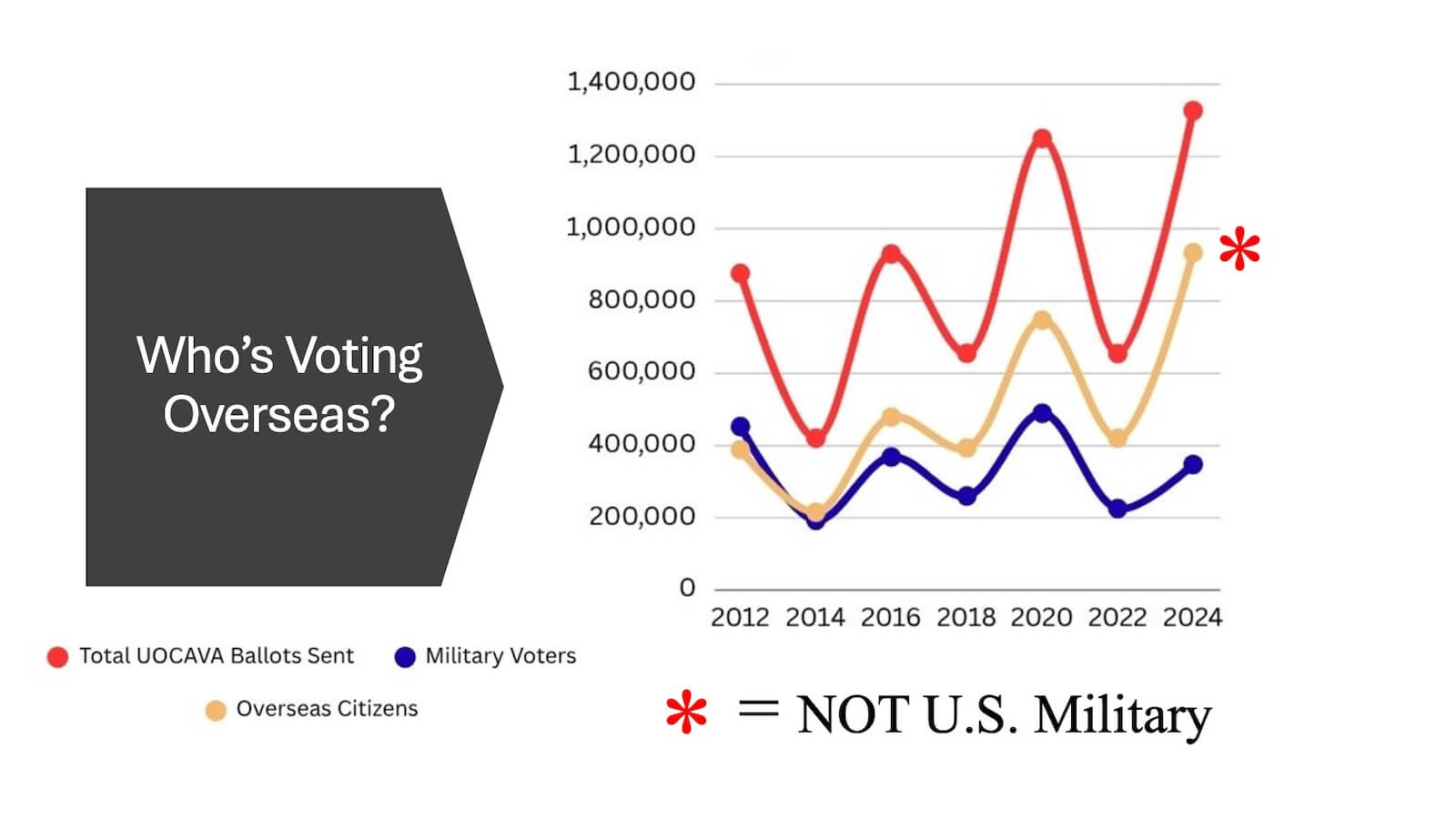
This foreign get-out-the-vote push has proven highly effective. During the 2020 COVID-19 pandemic, the U.S. government recalled thousands of overseas workers. Common sense dictates that fewer Americans were residing abroad during the 2020 cycle, yet total UOCAVA voter volume saw a massive surge (see chart up top).
Data indicates that overseas non-military voters outnumbered military voters for the first time in 2014, and that gap has broadened steadily since (source: Voter Reference Foundation).
While total UOCAVA votes have escalated, specific breakdown data isolating never-resided voters within the non-military category has never been tracked. Of course, Democrats say “almost no” illegal ballots are being harvested, but who believes them?
We the people deserve to know precisely how many individuals who have never experienced our culture—and have no intention of ever living here—are actively shaping our nation’s political future with their votes. Until then, the Trump administration is wisely rooting out “every possible” illegal voter.
Don’t know about you, but I voted for this.