
If I told you how bullish I was, you wouldn’t believe it. I have never been more excited about the future of America than I am right now. I am sold on Trump. I think he’s got a good shot at going down in history as one of our best presidents ever. What I’m seeing happening is absolutely nothing short of a great thing.
Ken Langone (Home Depot founder on CNBC)
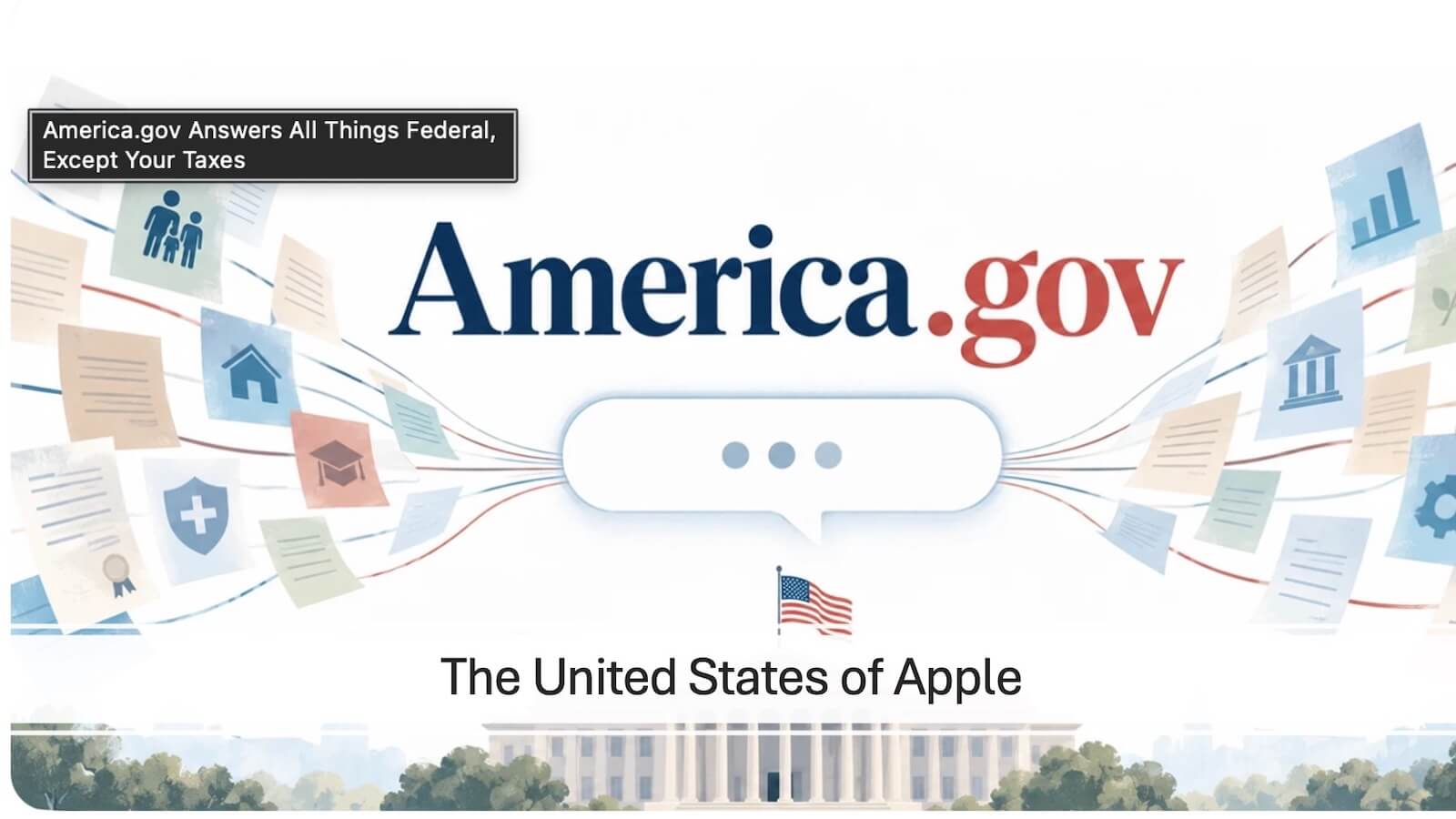
On a Tuesday in late September, President Trump hosted twenty top tech executives for a two-hour White House lunch, the signing of a “morally binding” accord to put guardrails on artificial intelligence (and witness an executive order to call the technology “super intelligence” in the federal government). Impressive, but the most consequential event of the day may turn out to be the launch of a website: America.gov.
Anyone who has renewed a passport, enrolled in Medicare, or dealt online with a gazillion federal web domains knows it’s a struggle for we the people to even understand the government’s internal org chart, and even harder to navigate to one of 24,000 federal web domains That was Obama’s count in 2011, long after Clinton promised a “one-stop shop” government to his fellow Americans. Now, almost 30 years later, a Republican administration is going to deliver.
America.gov is being built by the White House’s National Design Studio to run on the GSA’s infrastructure; the single “front door” to the federal government. Rather than navigating menus, users type questions in plain English into a chat window powered by Grok and Gemini and are quickly routed to the right information and forms.
Airbnb co-founder Joe Gebbia, who leads the design studio, described the shift simply: the burden moves from the citizen to the government. Instead of people figuring out which agency door to knock on, the government organizes itself around what the person needs. “You search,” he said, “and you never go back into the maze.”
The event was brilliant; resembling an Apple launch, with demonstrations rather than speeches. Rather than tell the audience how America.gov works, Gebbia showed how a user could buy a National Parks pass, apply for medical benefits or begin enlisting in the military. Medicare and Medicaid chief Dr. Mehmet Oz walked a recent retiree through her Medicare application. Secretary of State Marco Rubio showed how citizens could take their own photo, upload it, and receive the passport in a secure package by mail.
The President even signed another executive order, directing every federal agency to integrate its documents and services with America.gov. Every government website will be searchable through the portal immediately, with deeper integration of specific services happening in a matter of months (such as federal job applications, name-change filings and direct fee payments).
CNBC’s Andrew Sorkin, one of Trump’s loudest critics, so complemented the launch and America.gov that Squawk Box’s co-host, conservative Joe Kernen, paused the segment to memorialize the moment. Because Sorkin acknowledged that Gebbia’s and the National Design Studio’s successful move of federal-employee retirement to a fully paperless process, contrasting that to Obama’s laughable launch of HealthCare.gov.
Most voters will remain unaware of the launch but will remember how their own online dealings with government feel over the next two years – before the 2028 election. If that passport arrives on time, Medicare enrollment gets handled in one sitting, and questions get answered in plain English without a phone tree – small but personal experiences that add up – this year’s midterms won’t really matter.
If America.gov works as promised, tens of millions of Americans will have firsthand proof that Republicans – not Democrats – made the federal government faster, simpler and more respectful of their time. “Competent government” goes from slogan to something people talk about at the water cooler. The President framed it in those terms, saying Americans are used to a government so large that citizens feel small, and calling the site a way to put control back in the hands of the people.
It also serves the administration’s broader AI strategy. Public opinion on AI is sour, and the White House bets the best way to change minds is to make AI useful in exactly the places Americans find most frustrating. America.gov is a wager that competence can be demonstrated rather than claimed.
If a Republican administration delivers a portal that genuinely works, the political payoff will not come from a single news cycle. It will build quietly, one renewed passport and one completed benefits application at a time, as Americans notice that dealing with Washington has become easier.
Build quietly…one success at a time…this is the key to the all-important 2028 election, when 34 senate seats and the presidency are up for grabs. Not to dismiss mid-term Congressional elections, but I’d rather have a 6-3 conservative court and nation-changing presidential orders over the next two years. Because, already, the economic dominoes are falling into place.
In September, we learned headline inflation fell from 3.7% to 3.4% and 162,000 new jobs were added in August. Even better were the Q2 reports and revisions: (a) worker productivity rose 2.2%, (b) consumer spending growth rose from 0.7% in Q1 to 3.8%, (c) core underlying demand rose from 1.8% in Q1 to 4.6%, (d) non-housing investment grew at a 9% rate, and (e) residential investment rose 2.8% (its first gain since late 2024).
And, second quarter GDP growth was revised up from 1.5% to 2.2%. Not bad, especially with the Atlanta Fed’s September GDPNow reading of 3.7% and the BLS September Household Survey’s big reveal; 485,000 workers joined the civilian labor force, following a strong gain in August. The household data signals underlying macroeconomic momentum; growth amongst self-employed, gig, and small-business workers, who are not included in corporate payrolls.
Back to the opening quote, because Home Depot co-founder Ken Langone’s skill at reading the economy – in order to know where and when to expand his home-builder retail empire – is a proven quality. He’s paying attention to the massive amount of capital investment and becoming a Trump fanboy, because he knows his US economic history (see table below):
| Year | Total Cap-Ex Investment | Macro Insight |
| 1986 | $0.81 Trillion | Tax-cut boom |
| 1996 | $1.38 Trillion | Dot-com boom |
| 2006 | $2.48 Trillion | Housing boom |
| 2016 | $3.17 Trillion | Post-Great Recession boom |
| 2026 | $5.82 Trillion* | MAGA boom |
| * estimate | ||
Langone is convinced the Trump administration will deliver on its Golden Age of America campaign promise from 2024. And getting the federal government’s web portals to work like my Apple ecosystem (AppleTV, iPad, iPhone, iTunes and MacBook working seamlessly) is precisely the evidence I need to feel good about GOP prospects for 2028. This could get interesting.
Next week, I am diving into the 2026 mid-term elections by un-packing New York City’s electorate, why it voted for mad-liberal Mamdani, and what the RNC can learn from the Big Apple.