
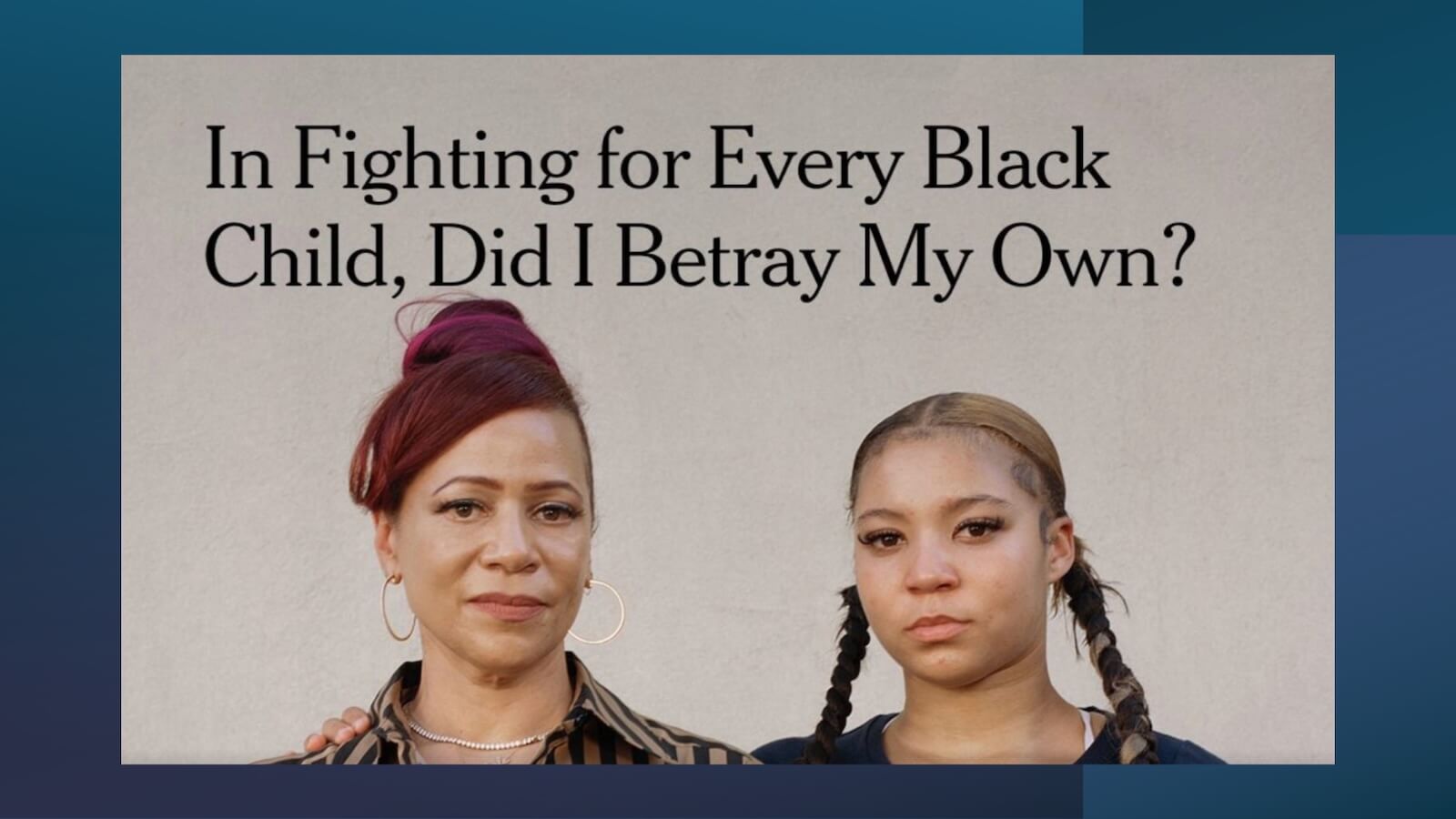
For all the time and effort Nikole Hannah-Jones spent claiming Black Lives Matter, turns out it was just posturing. Because the architect of the 1619 Project (her revisionist history of America) just admitted – in a sprawling essay for The New York Times Magazine – that she sacrificed her daughter, Najya, in an act of political martyrdom.
In a tragic mea culpa, Hannah-Jones admits to enrolling her child in a failing Brooklyn public school, despite having the income to choose a top private school. Still, rather than expressing guilt or shame, the uber-woke mom rages against the systemic forces of white privilege. Hmm…she had the money…she’s been writing about educational inequality for years…looks like a textbook case of bad parenting.
When Hannah-Jones looks back, she might claim “I did my best” for Najya, but she cannot claim “I did what was necessary.” We live in an increasingly sharp-elbowed world, where “good paying jobs” will be drained by silicon brains, and nobody in Beijing and Moscow will feel sorry for Najya. A mind is an horrible thing to waste, but that’s Najya’s story – – thanks to mom.
At the heart of the essay is a confession forced out of Hannah-Jones by her daughter. For too long, Hannah-Jones viewed her family’s school selections as a political – not practical – choice. She and her husband “felt an obligation to make educational decisions based on the collective good and not just our individual advantage” (her words, not mine).
Yet, as the years passed and the academic damage accumulated, the moral posturing collapsed under the weight of her daughter’s growing awareness. The central tragedy of the essay culminates in a series of heartbreaking admissions. Najya, upon discovering the reality of her school’s standing, confronts her mother directly: “So you had money to send me to one of the best schools, and you chose not to? Because other kids are disadvantaged, you didn’t want to put me in a great school?”
In that moment, the mother’s woke narrative dissolved into a simple reality: the child needed a mother, but found an activist instead. Hannah-Jones ultimately confesses her own failure: “When it comes to the choices my husband and I have made about public education, these days I feel that I failed both my values and my child. This girl, my only child, looked to me to protect her, to give her what she needed to thrive. And I had not chosen her.”
The confession is damning because it exposes the ultimate cost of prioritizing ideology over maternal duty. When Najya later tells her, “Sometimes I wish instead of always thinking about other kids, you would have thought about me,” she delivers an indictment that no amount of sociological theory can undo.
Rather than confronting the immediate, operational incompetence of the schools she chose, Hannah-Jones reflexively pivots to her primary intellectual framework: systemic rage and racial grievance. In her view, the failure of New York City’s public schools rests entirely with white families who choose better options, rather than with the administrators, teachers, and bureaucracy that fail to deliver basic instruction.
This narrative reveals a fundamental rejection of individual and institutional accountability—the very bedrock of a functional democracy. A self-governing republic (one woman, one vote) relies on citizens and institutions taking ownership of their duties (ask not what your country can do for you…).
Yet throughout the narrative, basic administrative breakdowns—unsupervised lunchrooms where children run wild, uncorrected classwork, and unadministered reading assessments—are externalized as the inevitable byproduct of broad structural inequality. Even the educators within these schools succumb to this dynamic.
Najya’s middle school principal, Emily Paige, admits to eliminating homework out of a misguided pursuit of “equity,” only to realize it crippled the students when they transitioned to rigorous environments. As Paige eventually concedes: “It is important to not, in our pursuit of being antiracist, lower expectations… Because this is what happens, right? It’s racism under the guise of antiracism.”
By substituting identity politics for personal responsibility, the system—and the advocates who justify its failures—relieves individuals of the duty to perform. When basic standards of competence are dismissed as tools of oppression, the result is not liberation, but institutional decay.
Beyond the political rhetoric lies a stark reality: Hannah-Jones failed in her primary obligation as a parent. The fundamental purpose of parenting, mirrored in the classical tradition of education, is to cultivate the skills and character one’s child needs to become a capable, independent adult.
Instead, Hannah-Jones used her daughter as a credentialing pawn and a ideological symbol. Her account reveals an oddly disengaged parent who spent years writing articles and speaking on national stages about school segregation while remaining shockingly detached from the day-to-day mechanics of her own daughter’s learning.
It was only when Najya entered a selective high school and found herself “drowning” that the full extent of the neglect became clear. Najya had never been taught how to study independently. She had passed eighth-grade math with A’s, yet a basic assessment revealed she lacked fundamental arithmetic skills: “The center’s director called me in and told me that Najya knew very little algebra and had huge gaps in many of the building blocks of math that she should have learned in elementary school, like mastery of long division and fractions.”
It never occurred to Hannah-Jones that ensuring her child mastered basic long division, fractions, and study habits was primarily her job as a parent—especially when she knew the school was failing to provide them.
Classical Western education understands that the goal of schooling is the formation of the student’s mind and soul through exposure to what is good, true, and beautiful. Utilitarian education seeks to build concrete skills for self-sufficiency. Hannah-Jones rejected both models, treating education as merely an arena for political warfare.
Parents who truly understand the purpose of education know that a child is not a tool for social engineering. That is why millions of families across the nation are abandoning failing district schools in favor of charters, private options, and classical homeschooling. They recognize what Hannah-Jones learned too late: when a parent chooses to make a political point rather than make a capable adult, it is always the child who pays the price.