
The blame solely lies on the leadership in the House and the Senate because we did not do what we said we were going to do. We said we were going to require voter ID and proof of citizenship to vote in our country, passed that bill four times in the House, and that bill is still sitting in the Senate.
Rep. Greg Steube (R-FL)
This is the first installment of a three-part analysis breaking down the post-midterm election landscape—a result that has left Democrats giddy and Republicans pointing fingers.
This post focuses on the fundamentals that worked against the GOP. Next week’s post will examine what to expect from Congressional Democrats over the next two years as the political apparatus shifts toward the 2028 presidential cycle. The final post will deliver a self-scout for the Republican Party, outlining a strategy to rebuild trust and effectively compete in 2028.
A Nation Blinded by Animus
Remember when leaders of both political parties gathered on the steps of the U.S. Capitol after 9/11 to sing “God Bless America” side by side?
Look at Washington today and it becomes impossible to ignore how partisan loyalty has supplanted national interest. Today’s Democratic establishment routinely puts party before country—and the MAGA movement, frankly, isn’t much better. This total collapse of bipartisanship is slowly paralyzing the nation.
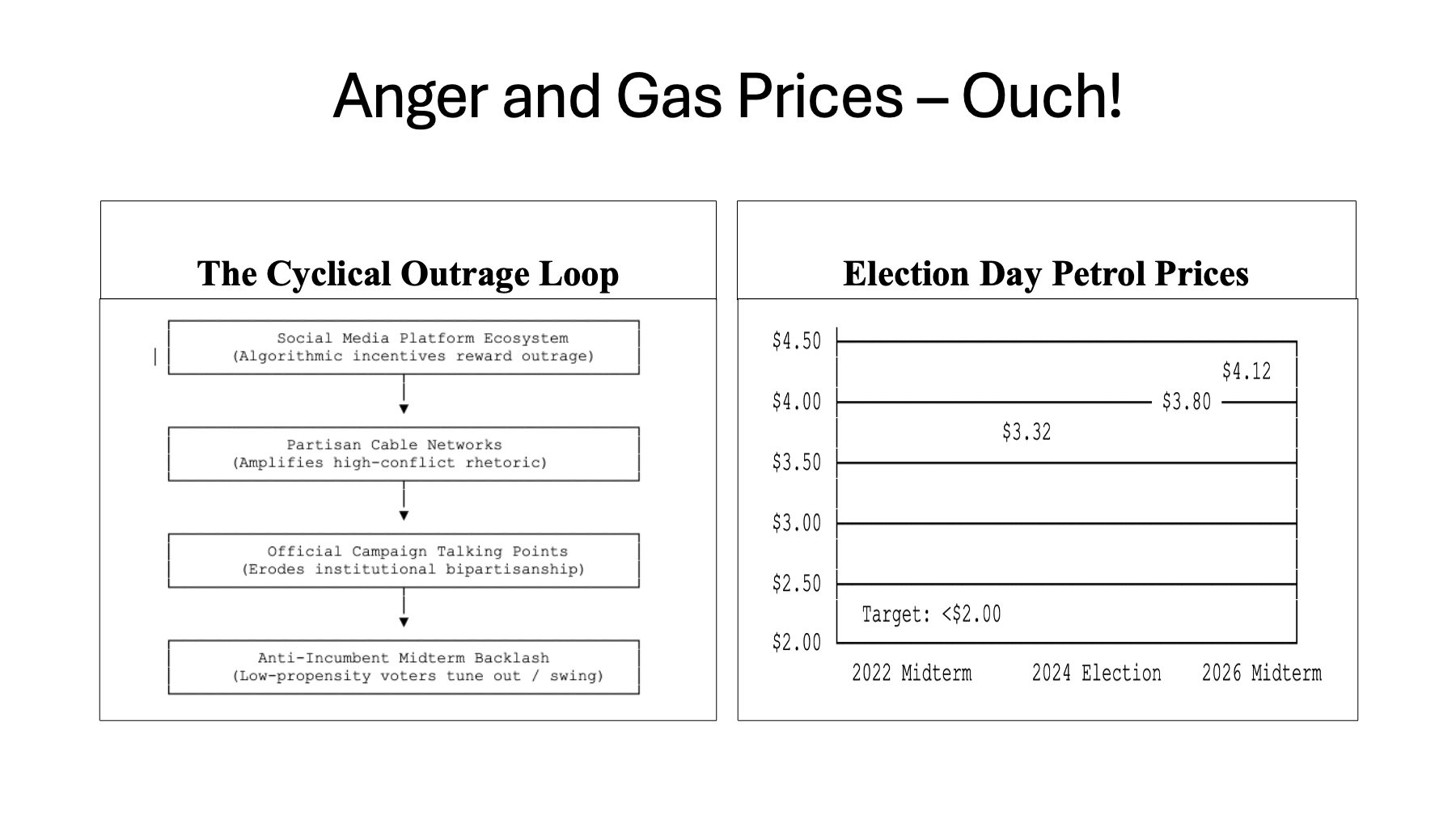
The underlying poison in American politics is incendiary rhetoric. It originates on social media—where nuance and common decency go to die—gets amplified by partisan cable networks, and eventually embeds itself directly into official party talking points. The end result is the non-stop argument we’ve endured over the past two years, where Congressional committee hearings have degenerated into little more than high-visibility intellectual food fights.
While it is overly simplistic to pin the entire culture shift on President Barack Obama, it was during his presidency that social media matured into the primary arena for political discourse. Over the past decade, algorithmic incentives have steadily accrued influence to the most extreme voices on both edges of the spectrum—from Tucker Carlson on the populist right to Hasan Piker on the progressive left. That digital outrage machine peaks during midterm elections, when hyper-partisan activists effectively take control of online narratives.
Low-propensity voters who turned out in 2024 were turned off by this relentless animus and simply tuned out in 2026. Moreover, the hyper-partisan commentary posted online by political operatives often reveals a fundamental flaw in character. There is a reason candidates and political appointees frantically delete their past social media posts the moment they are up for a ballot line or confirmation: deep down, they know their posts were neither civil nor truthful.
Sadly, these digital “Samuel Adams” wannabes have sustained a bitter 20-year trend of electoral punishment for whichever party holds the White House:
- 2008 – Obama won in 2008, only to lose 63 House seats to the angry “Tea Party” movement in 2010
- 2016 – Trump won in 2016 and lost 41 House seats to the angry “Resistance” movement in 2018
- 2020 – Biden won in 2020, and the aggrieved “Stop The Steal” movement could not even wait two years
- 2024 – Trump won in 2024, and the angry “No Kings” movement picked up 40 seats in 2026
Credit Democrats and their media allies for launching their campaign message on Inauguration Day and sticking to it through the fall. They effectively orchestrated an autumn of discontent that altered voter perception and depressed Republican turnout. At the same time, praise is hardly due for turning every federal funding deadline into a government shutdown crisis, or for failing to reach a practical compromise on the Safeguard American Voter Eligibility (SAVE) Act—a basic measure requiring proof of citizenship for federal elections that enjoys broad support among everyday Americans.
The Issues That Mattered
Three dominant issues—economic anxiety, government corruption, and foreign policy friction—dominated exit polls nationwide, sparking an anti-incumbent environment not seen since the post-Watergate elections:
| ISSUE | SHARE OF VOTERS CONCERN | DEMOCRATS WON |
| Cost of Living | 87% | 58% (+16%) |
| Government Corruption | 82% | 80% (+60%) |
| Iran War & Foreign Policy | 74% | 63% (+26%) |
Back in July, former House Speaker Newt Gingrich delivered a warning to The New York Post: “If you tell me the price of gasoline on Labor Day, I’m pretty confident I can tell you about the election.”
Gingrich proved prophetic. On Election Day, the U.S. national average for regular gasoline stood at $4.12 per gallon—setting a record high for an Election Day and breaking the previous record set during the 2022 midterms. Compare that to President Trump’s September 2024 campaign promise: “We’re getting gasoline below $2 a gallon, bring down the price of everything from electricity rates to groceries, airfares, and housing costs.” Millions of working families were left asking where that relief went.
High costs for basic necessities always punish the governing party. This year, voters attributed high fuel and grocery prices to a mix of aggressive tariff policies and supply disruptions linked to the conflict with Iran. This economic blowback created noticeable fatigue within the populist base. Specifically, younger populists and working-class voters—who are acutely sensitive to both military entanglements and energy prices—did not turn out at their 2024 levels.
Meanwhile, ethics emerged as the sleeper issue of the cycle, with over 8 in 10 voters calling government corruption a central factor in their decision. The narrative was further amplified by public infighting within the administration’s orbit.
Discontent erupted into public view when high-profile figures from the Make America Healthy Again (MAHA) movement openly accused outgoing White House Chief of Staff Susie Wiles of siding with corporate lobbyists over policy reforms. This criticism echoed comments made earlier by Florida Governor Ron DeSantis on The Stephen A. Smith Show, where he publicly lamented D.C. ethics and recalled selling off his entire stock portfolio upon entering Congress in 2012 to avoid even the appearance of self-dealing. Combined with the “No Kings” narrative, Democrats successfully convinced 70% of voters that Congress had failed to provide adequate checks on executive power.
America First Squanders Its 2024 Gains
In 2016, Donald Trump famously asked Black voters, “What have you got to lose?” In 2024, that pitch resonated with a broader coalition—including young voters, Hispanics and black men—who felt battered by post-pandemic inflation and rising living costs under the Biden administration.
That broad coalition delivered a Republican sweep in 2024. But by 2026, key segments of that coalition had retreated (see table below):
| VOTING BLOC SUPPORT FOR TRUMP | ||
| 2016-2024 Gains | 2024-2026 Losses | |
| Voters Aged 18-29 | + 10% (37%-47%) | – 22% (47%-25%) |
| Hispanics | + 14% (29%-43%) | – 9% (43%-34%) |
| Black Men | + 12% (13%-25%) | – 15% (25%- 10%) |
The erosion among young and working-class voters reflects how quickly political realignments can stall if working-class conditions fail to improve. Disapproval of aggressive deportation tactics, anxieties over executive ethics, and persistent price pressures at the pump led key elements of the 2024 coalition to either stay home or swing back toward opposition candidates.
When working families feel the squeeze of $4.00 gas alongside headline news about political insider trading and foreign entanglements, campaign rhetoric loses its punch. The GOP learned the hard way in 2026 that winning a coalition is only half the battle—keeping it requires delivering clear, visible relief where it matters most.
THE GROUND GAME
What we can discern are some of the GOP’s ground-game blunders, like nominating the late Lindsey Graham’s sister to fill his Senate seat. No joke, because Lindsey won 1,369,137 in his last election, dwarfing the vote count for both Democrat Annie Andrews (1.04 million) and Republican Darline Graham (952,000 votes). After watching Democrats anoint Kamala Harris to disastrous results, I was shocked to see Republicans repeat the mistake in reliably-red South Carolina
What we cannot (yet) measure are the number of illegitimate ballots cast on behalf of Democrats, but suffice it to note two truths. One, Republicans attempted numerous election-integrity measures, from the House passing the SAVE ACT to the Post Office trying to verify voters and addresses. Two, Democrats never offered a compromise election-integrity bill, but did fight federal attempts to alter election rules or deploy monitors in six major federal court cases, on top of dozens of distinct procedural filings to stay federal involvement.
Why fight tooth and nail against a voter-ID law supported by over 80% of Americans? I cannot think of one legitimate reason…and that’s the elephant in the room. The guess here is that, just like Democrats engineered record-setting presidential vote totals in 2020, they’ve done the same for mid-term totals in 2026.