
The course we take will determine whether the West maintains its place at the head of the world or resigns itself to a future of atrophy and servitude and decline. We will either choose to act now or lose the choice to act at all.
Marco Rubio
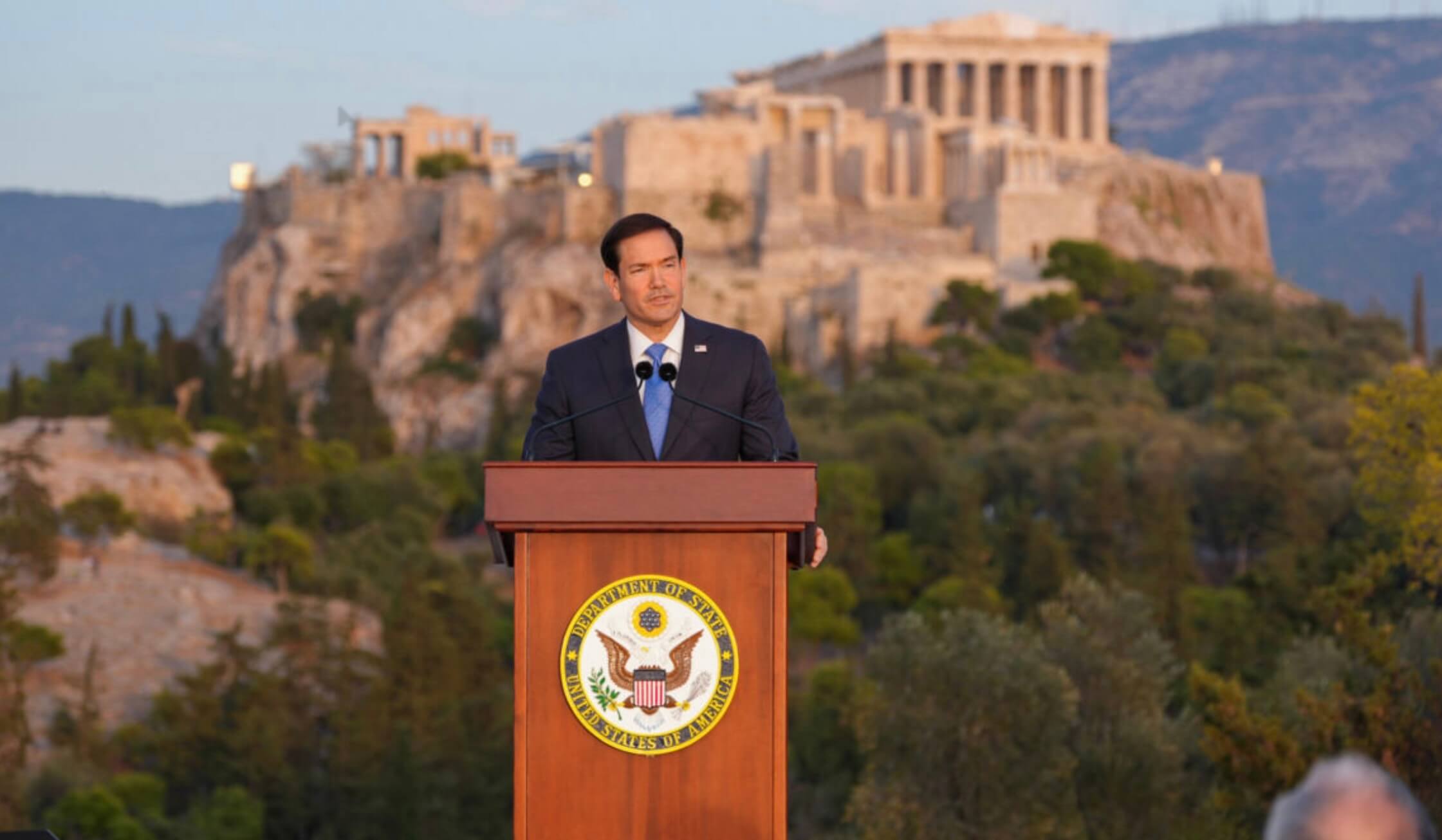
On the evening of Wednesday, October 7, Secretary of State Marco Rubio stood on the Pnyx, the rocky hillside where Athenian citizens first gathered to govern themselves. The Parthenon rose behind him, and the speech was timed so the sun set as he spoke. Few American diplomats have chosen a more symbolic stage, and fewer still have risen to it. Rubio did. His address was robust, heartfelt, unapologetic, and true.
Rubio was in Greece for NATO consultations and the sixth U.S.–Greece Strategic Dialogue. He could have delivered the usual communiqué about energy corridors and defense cooperation. He did praise Greece as a model ally on energy, migration, and defense. But he used the setting to make a larger argument. It completed a theme he began in Munich in February, when he told European leaders that America, whatever its hemisphere, “will always be a child of Europe.” In Athens he traced that lineage to its source.
In contrast to Vice President Vance, whose meta-message is too often America can go it alone, Rubio is an alliance builder and much needed antidote to our ally-bashing president. He began with the familiar debts. “Greece is literally carved into the architecture of our government,” he said, “in the towering columns, in the domes and the monuments across our capital city.” Even the birthplace of the Constitution, Philadelphia, carries a Greek name.
Rubio insisted, though, that columns and assemblies were only the outward expression of something deeper. In Athens, he argued, the West first found “fierce individuality and relentless ambition; daring exploration and invention; a yearning for discovery, for adventure, risk and glory.” The Greek city was an arena where men tested themselves in perpetual struggle, straining to be the best. “What blossomed here in this place,” he said, “was the Western desire to uncover all that ignorance, darkness, and distance had kept hidden from the mind of man.”
Athens bequeathed us more than a culture. It gave us what Rubio called a “common anthropology,” a shared view of man’s place in the universe: objective standards of virtue, a natural order, truth, goodness, and beauty worth striving toward. Not long ago this was the common mental furniture of most Americans. It powered our free markets, our science, and our ordinary ambition to excel.
Rubio’s diagnosis of what went wrong was blunt. “Too often these days, we build downwards,” he said. “We design our standards to ensure no one will lose; we preoccupy ourselves more with the comfort of the worst than the potential of the best.” Anyone who has watched our schools trade honor rolls for participation trophies will recognize the culture of Lewis Carroll’s Dodo, who declared that “everybody has won, and all must have prizes.” The Greeks called the missing quality thymos, spiritedness. Its absence produces what Nietzsche called the Last Man: comfortable, timid, and incurious.
That timidity, Rubio argued, turned into shame. “The word ‘nationalism’ became a dirty word. And so we tore down our monuments; we condemned our own history.” Americans who lived through the statue-toppling summer of 2020 and the vogue for the 1619 Project know what he meant. The consequences were material as well as spiritual. We opened our borders, outsourced our industry, let our militaries decay, and shipped our sovereignty off to global bureaucracies beyond the reach of voters.
Then came the turn that made the speech memorable. “Under President Trump,” Rubio said, “the United States has made its choice.” That choice is “the unapologetic pursuit of national power”: reclaiming supply chains, reindustrializing, rebuilding the military, and competing to dominate the technologies of the future, from advanced manufacturing and artificial intelligence to chips, drones, and space. Statecraft, he reminded his audience, requires the ability to use force when diplomacy fails, and the credibility that you will. He made the point concrete. Invoking the Spartans at Thermopylae, he contrasted the Western ideal of sacrifice for one’s city with the “cult of death” promoted by Iran’s radical mullahs. With America now at war with Tehran, those words were not mere rhetoric.
The speech was aimed squarely at Europe. “We believe that Europe can awaken from its long slumber,” Rubio said, “and rekindle the fire that was lit here millennia ago.” Here he reached for an American precedent. When the Greeks rose against Ottoman rule in 1821, Americans saw their own revolution in that struggle. In 1824 Daniel Webster told Congress that our free assemblies, our debates, even our columns reminded us that we, like the rest of mankind, are “greatly her debtors.” Rubio’s point was that the debt runs both ways across the Atlantic. Some European commentators noticed the difference in tone from Vice President Vance’s scolding in Munich in 2025: Vance rebuked Europe for squandering its inheritance, while Rubio invited it to reclaim it. The message was not “go it alone.” It was “become strong enough to remain a credible ally.”
The usual critics were unimpressed. Some called his history selective; others dismissed the address as an early audition for 2028. Every civilization’s account of itself is selective. The real question is whether the story is worth telling and whether it inspires people to live up to it. Rubio’s does.
Nor was it unprecedented. In Warsaw in 2017, President Trump offered a similar defense of the West, closer in spirit to Pericles’ Funeral Oration than to a State Department briefing. “We write symphonies. We pursue innovation,” Trump said then. “We reward brilliance. We strive for excellence.” Rubio walked deliberately in those footsteps, and he did so on the very hill where Pericles’ Athens debated its fate.
Conservative commentator Roger Kimball heard Rubio’s speech and recalled C. S. Lewis, who warned of “men without chests” (i.e. people educated out of the spiritedness that makes courage and virtue possible). Kimball noted that the old American word for thymos is gumption.
And, from the Pnyx, Marco Rubio asked the West to find its gumption again. It was a rousing tocsin. One hopes the nations of the West, on both sides of the Atlantic, were listening, because advanced civilization depends on it.