
Between 2010 and 2015, while Russia and China tripled their defence budgets in real terms, European Nato members accumulated an $8 trillion defence spending deficit compared with the United States. Furthermore, not a single EU company worth more than €100 billion has been built from scratch in the past 50 years. In that same period America created six worth over €1 trillion each.
The Times of London
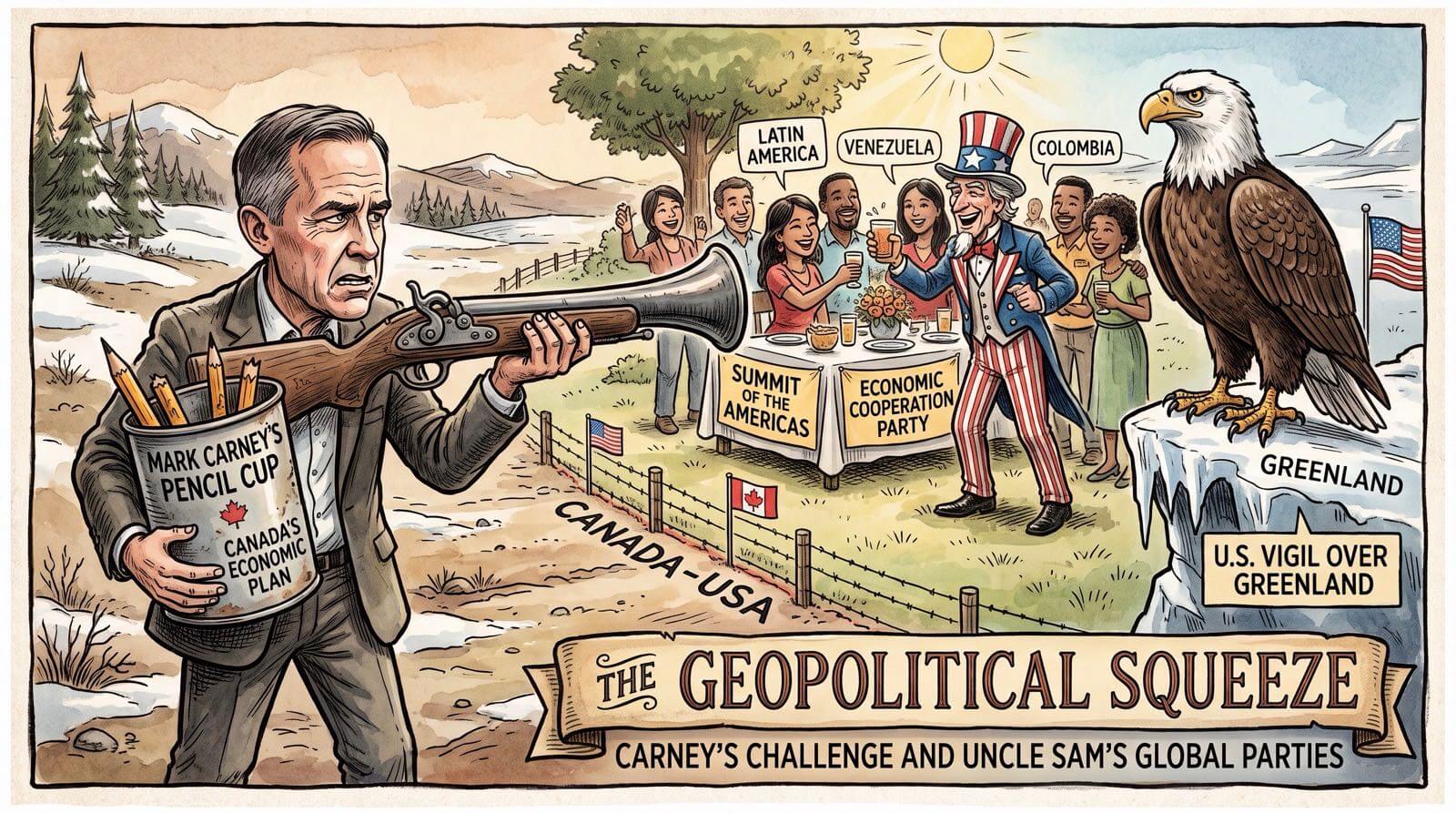
When Canada’s Mark Carney ended bilateral trade talks with the US and publicly wished for “associate membership” in the EU, he might have done his southern neighbors a favor. Why should American taxpayers underwrite a multi-billion-dollar security and trade architecture for a neighbor that operates as an echo chamber for Brussels?
What Carney calls a “new” association is no such thing. He’s simply formalizing what’s been true since long ago, when Canada rejected the US model in favor of the European bureau-state; embracing “globalist” dogma that allows Chinese transshipments, enacting “net-zero” climate mandates that invite affordability crises, and free-riding on America’s unilateral defense of the western world.
Don’t look now, but Washington is rapidly investing its economic, trade, and national-security capital for the next century in Latin America. Smart, because the US needs to replace China’s low-cost labor and make investments that help stop the flood of drugs and migrants entering the U.S. from the south.
Note to Mark: once the US is aligned with Los Otros Americanos, Canada’s goose is cooked. Don’t scoff, because the tale of the tape says making America great again can best happen by partnering with Mexico, Central America, and South America, not Canada – and it’s not even close. Get inside the numbers, and you’ll see why!
Choose a $6.5 trillion powerhouse over a $2.1 trillion stagnant economy. In international statecraft, size dictates leverage and long-term market opportunity, and Canada simply cannot match the scale and scope of Latin America.
It starts with population disparity. Canada’s 41 million represents a tiny fraction of the Western Hemisphere – not even 1/16th the size of Latin America. Mexico, Central America, and South America represent a combined market of over 660 million people, boasting a young, dynamic workforce ready to power regional growth. Canada is anything but dynamic, burdened by record-low fertility rates; 1.25 children per woman.
Money makes the world go ‘round, and Canada’s nominal GDP of roughly $2.1 trillion is barely half California’s $4 trillion. In comparison, Latin America represents a combined $6.5+ trillion economic bloc. Canada is post-peak, relying heavily on government spending and US consumers, while Latin America offers a massive consumer market with decades of demographic dividends ahead.
Choose 21st century dominance over legacy northern assets. Economic growth must be forward-looking, and the USA should’ve been looking southward the minute Bill Clinton allowed China into the WTO.
Start with the US economy’s need for low-wage manufacturing (which is the ONLY reason I out-sourced to the PRC). Buying from Canada means paying high prices that are inflated by stringent labor regulations and heavy carbon taxes. Buying from Latin America means near-shoring manufacturing to low-wage, resource-rich allies; thereby keeping consumer prices low without enriching our communist arch-rival.
Canada’s primary exports – crude oil, potash and soft lumber – are the commodities of yesteryear. In contrast, Latin America controls the critical building blocks of tomorrow. The “Lithium Triangle” of Argentina, Bolivia and Chile holds 60% of global lithium, while Chile and Peru account for 40% of global copper. Brazil holds 98% of the world’s Niobium, which is essential for high-strength steel alloys, and provides, alongside Argentina, year-round agricultural scale that dwarfs Canada’s seasonal yield.
America’s goods and services exports deserve something better than Canada’s saturated market of 41 million people. Selling to Latin America opens an expanding middle class of 660 million consumers eager for American technology, machinery, financial services, and agricultural products – a surefire way to help make America great again.
Choose right-leaning pragmatists over left-leaning ideology. A reliable partner must share a common direction with the United States, and Canada’s leftward drift is no match for Latin America’s conservative realignment.
Like most of the EU, Ottawa has increasingly embraced expanding state regulation, heavy carbon taxation, government-subsidized green mandates, and aggressive social engineering. More critically, Canada has shown a willingness to court Beijing; lowering tariffs on Chinese state-backed EVs and risking the security of the integrated North American auto grid.
In contrast, across most of Latin America, pragmatists are leaning into market-oriented economics, border security, and regional cooperation. Increasingly, leaders across the region recognize that economic integration with the United States is the fastest engine for lifting millions out of poverty and countering internal corruption.
Choose hemispheric defense over a free-riding neighbor. When it comes to national safety/security, America deserves a true partner who contributes to mutual defense rather than taking security for granted. Canada has consistently failed to meet NATO’s baseline defense spend of 2% of GDP, because Ottawa trusts the US military to protect its Arctic frontiers, shipping lanes, and skies above.
In contrast, 12 Latin American countries have already signed onto the Shield of the Americas (AKA the Americas Counter Cartel Coalition) launched at the Doral summit in March 2026. By granting U.S. market access, Washington is growing a security and trade alliance to achieve three America First goals:
- Destroy criminal cartel networks throughout the hemisphere
- Stop illicit mass migration
- Permanently expel Chinese, Russian and Iranian infiltrators
Late-breaking Friday, the leaders of Denmark and Greenland corroborated President Trump’s announcement of an agreement giving the US “permanent control over security, and all other needs, in Greenland, completely addressing ALL of our many U.S. concerns” (source: ABC news). This includes building US military installations and blocking Russian and Chinese interests in the region.
Meanwhile, Mexican President Sheinbaum announced Friday that her government was doing everything in its power “to reach a trade deal soon” with the United States, adding that Wednesday’s call with President Trump was “very good” and that numerous agreements had been reached (source: US News).
Coupled with the US-Venezuela energy agreement, these announcements put a new light on Mark Carney’s anti-American posturing: America does not need to accept being lectured by an uncooperative northern neighbor when its southern neighbors are ready to build the ultimate Pan-American future with fair trade, mutual prosperity and shared security.
Back to Carney’s EU play, suffice it to note that Iceland, Switzerland, and the UK recently rejected deeper integration or full-fledged membership in the 27-country bloc. That should be a red flag for Canada; which, without access to the US market, will probably face severe economic contraction. Note to Mark: listen carefully to hear “no es nuestro problemo” being sung south of the border.