
Are states going to alter envelopes? That’s insane, unconstitutional, impossible. Over my dead body is that rule going to go into effect. We are going to fight this tooth and nail.
Arizona AG Kris Mayes (D)
If Arizona’s Democrat attorney general is willing to die to prevent unique barcodes on each mail-in ballot’s envelope, she’s either nuts or hiding something. Oh well, mid-term-election madness is officially here. And, beyond the heated rhetoric and legal posturing over mail-in ballot procedures, Republicans occupy the common-sense high ground, while Democrats are busy constructing a losing political issue for 2028.
Yes, documented election-fraud convictions in blue states remain relatively rare. But that misses the point. The American public wants tighter, more verifiable controls over the election system, full stop. Gallup finds 84% of Americans favor requiring photo ID to vote and 83% support requiring proof of citizenship at registration; Pew backs this up, putting photo-ID support at 83%, up steadily from 77% in 2012. Even clear majorities of registered Democrats support the baseline provisions of measures like the SAVE Act. Voters don’t see basic verification as disenfranchisement. They see it as administrative common sense — and Democrats keep talking about it as if it were a fringe GOP talking point.
Strategically, Democrats are betting that holding even one chamber of Congress keeps the SAVE Act dead for the rest of Trump’s second term. That bet may pay off legislatively. But it ignores that the White House no longer needs Congress to get what it wants.
The Executive Workaround
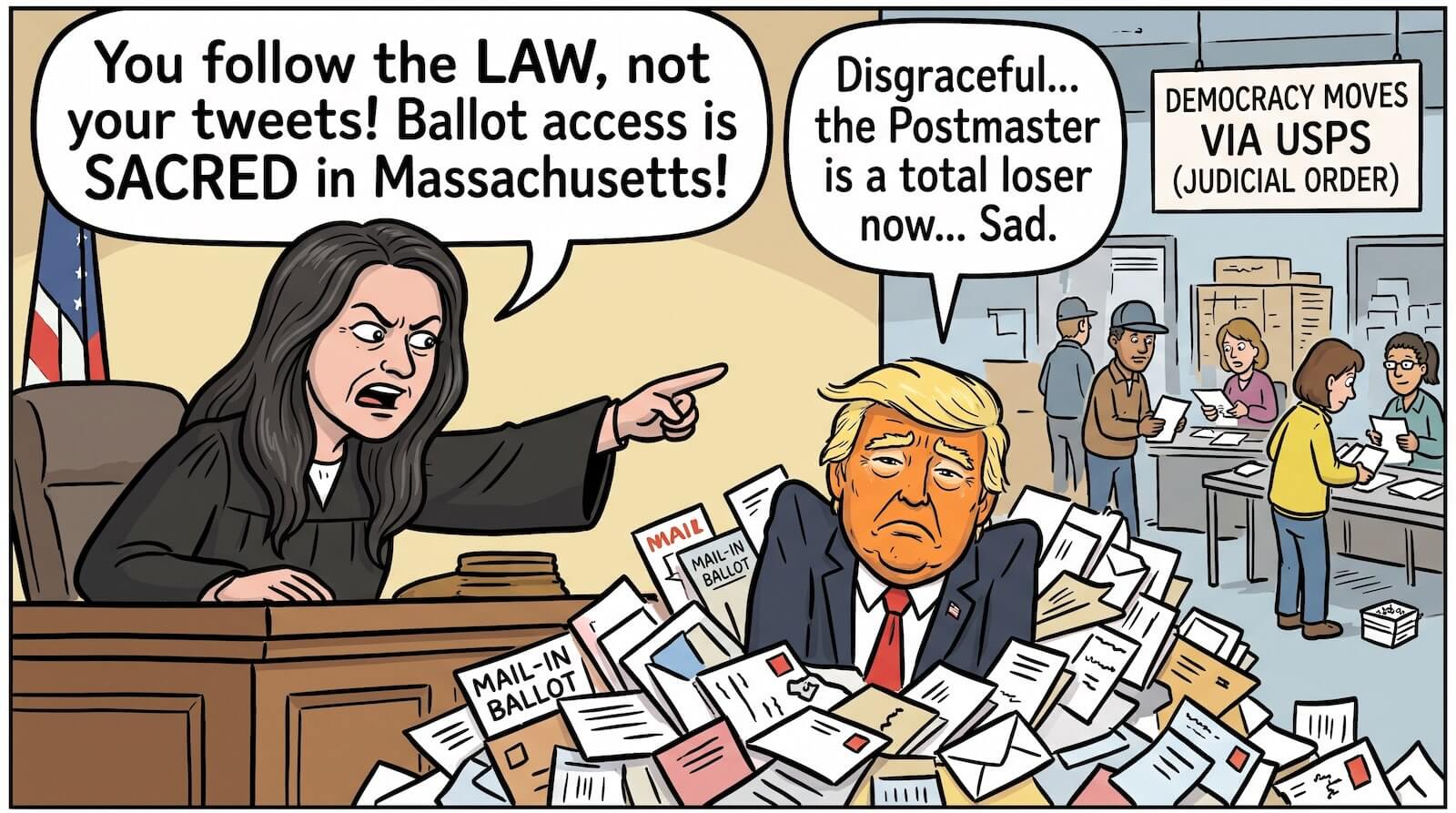
Hedging a legislative solution, the administration played the USPS card. The U.S. Postal Service’s final rule for Federal Ballot Mail (39 CFR Part 111) — issued under Executive Order 14399, and cleared for execution once the Supreme Court swept away the lower-court injunctions blocking it — builds a three-part verification system that Congress could never pass on its own:
First, the Department of Homeland Security compiles a state-by-state citizen count from Social Security and immigration records, to be shared with all 50 states.
Second, the USPS rule requires states that want to use the mail for ballot delivery to upload their ballot-recipient lists — names, addresses, and unique Intelligent Mail barcodes — into a central Federal Ballot Mail Portal, generating a real-time ballot tally that can be checked against the DHS citizen baseline. Postal facilities scan every outbound ballot mailing against that portal; if a state hasn’t completed its data entry or ignores the design standards, USPS simply refuses the bulk mailing.
Third, the Attorney General is directed to prioritize prosecuting officials who knowingly distribute ballots to ineligible voters.
Notably, none of this touches state prerogatives. States keep full control over their voter rolls and eligibility rules. Postal workers won’t open a single envelope or inspect ballot contents — the rule governs only exterior mailpiece compliance and chain-of-custody data. This is logistics and visibility, not partisan overreach.
But the political payoff is real. If a state’s mail-ballot distribution significantly exceeds its DHS-verified citizen count — 1.3 million ballots against a baseline of 1 million citizens, say — that’s a hard, undeniable data point, not a talking point. The barcode system does the same work at street level, flagging suspicious address clusters and delivery anomalies before anyone sees a courtroom. It’s not a passive scorekeeping exercise; paired with DOJ’s prosecutorial mandate, it’s an active enforcement tool. If the resulting variance is trivial, Republicans lose a talking point. If it’s substantial, they gain an ironclad one. Either way, the White House gets what a stalled Senate bill never could: concrete evidence instead of endless debate.
This postal rule doesn’t stand alone. It’s one piece of a broader administrative push that includes the State Department moving to revoke up to 200,000 visas held by asylum-filers, ICE recording more than 50,000 arrests in a single month, and DHS launching targeted, random audits of paper ballots to address concerns about voting-machine software security.
The Real Tell
Here’s what should worry Democratic attorneys general: “we have no evidence of voter fraud” is not the same statement as “we don’t believe a 300,000-ballot variance is worth investigating.” Voters intuitively grasp the difference. The first is a defensible position when nobody has run the numbers. The second is a purely political choice — and it’s the choice blue-state officials are making by spending enormous legal capital trying to block the data from ever being generated, rather than letting USPS build the portal, publish the numbers, and settle the question permanently. If they were confident the comparison would come back clean, that would be the obvious move. Instead, their legal strategy targets the measurement mechanism itself, on separation-of-powers and privacy grounds, before a single metric can be compiled. To a swing voter watching from the outside, the party insisting election vulnerabilities are a myth is working overtime to make sure no one can measure them — and that contradiction, not any brief filed in federal court, is what will stick.
Whatever one thinks of Trump personally, a decade of absorbing legal fire from special counsels, state prosecutors, and civil litigants has left him with little instinct to simply trust bureaucratic self-reporting. His approach to voter-roll integrity isn’t political theater — it’s an executive using the tools already available to him (DHS, DOJ, USPS) to generate hard numbers instead of unresolvable accusations.
If the resulting variances turn out to be negligible, this administration will have done more to restore faith in election outcomes than a decade of cable-news debate combined. If they’re large, the country will have learned something it needed to know. Either way, unique barcoded envelopes and a reconcilable federal mailing portal are simply standard operational common sense — and Democrats keep opposing that at their own political peril.