
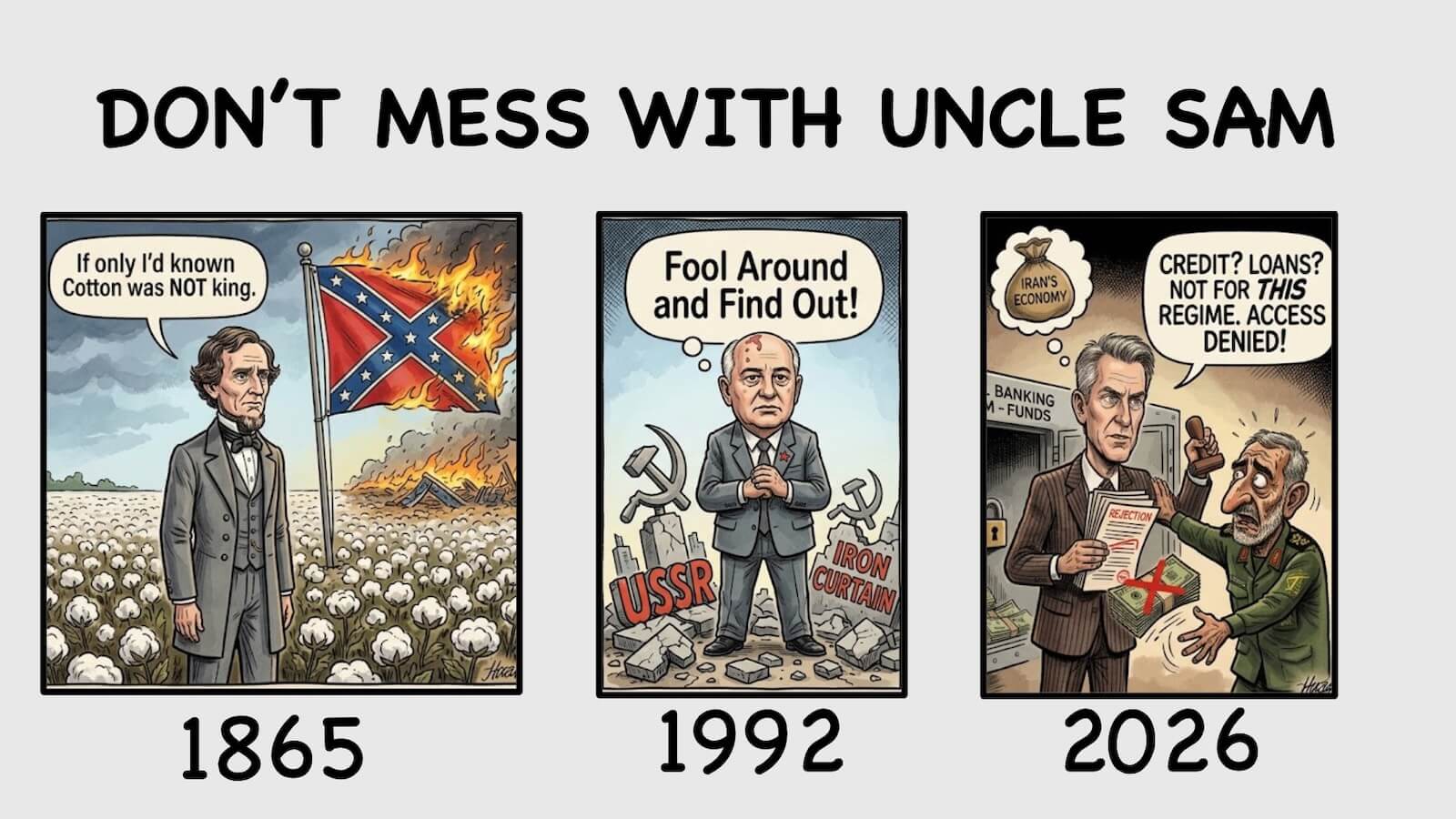
Let the message to the IRGC be clear: If you shoot at two of our ships, we will impose an even higher economic cost – taking out three of yours. We will not hesitate to defend American forces, and if necessary, destroy Iran’s limited and exposed oil fleet.
Adm. Brad Cooper (Centcom commander)
Today, after Iran’s “limited and exposed oil fleet” was hit by Centcom, America’s adversaries must re-think the chessboard. From experience, Trump knows that no entity (even Iran) can survive unless it pays its bills. Which is why he’s tasked Treasury Secretary Bessant with breaking Iran. Operation Economic Outcast is now strangling Iran financially; sanctioning banks that process Iranian funds, and securing the EU’s formal endorsement and secondary sanctions, while the US Navy deprives the regime of oil exports.
Three destroyed tankers left Iran’s leaders obviously flummoxed Saturday because, while Iran’s Foreign Ministry condemned the attacks as a “war crime” by the US, the IRGC’s deputy for political affairs said the US Navy had not caused “the slightest disruption.” Oops!
It’s obvious this White House knows threats from the Axis of Evil cannot go unchecked. Not with Russia’s expansionist warfare, Iran’s constraint of Middle Eastern oil, China threatening to withhold rare earth minerals, and North Korea’s nuclear proliferation. And, it is increasingly obvious Team Trump is trying to re-set the long game against that very same axis.
That long game turns energy—oil, natural gas, and the grids that power them—into the primary battlefield of the 21st century. Victory looks like starving Iran and Russia of capital, denying China cheap fuel, and proving to key regional powers like India and Japan that aligning with Washington remains the single smartest move on the board. Three core realities underpin Mr. Trump’s doctrine:
- The AI Energy Race: Power-hungry artificial intelligence infrastructure will dictate which nation—the United States or China—claims global dominance.
- Resource Leverage: Controlling or redirecting Iranian and Venezuelan energy flows grants Washington unprecedented geopolitical leverage.
- A Strengthened Quad: The anti-China coalition of Australia, India, Japan, and the U.S. is hardening into an indispensable operational alliance.
No question, Trump understands the paramount importance of energy dominance to achieving his national defense and economic vision. In stark contrast, Iran made the fatal mistake of weaponizing Middle Eastern oil, a blunder echoing the Confederacy’s failed “King Cotton diplomacy” during the American Civil War.
In 1861, the South thought its near-monopoly meant a cotton embargo would force European intervention. Self-defeating, because Britain and France simply turned to accumulated stockpiles, rapidly built out new supply chains in Egypt and India, and watched that “near-monopoly” (and nation) become Gone With The Wind by April 1865. Tehran will learn that exact same history lesson soon enough.
To understand what awaits Tehran, look to September 13, 1985. On that day, Saudi Arabia announced it would no longer prop up crude prices. Global oil prices collapsed, the USSR lost $20 billion annually in hard currency, and Moscow soon could not fund its empire. Yegor Gaidar, Russia’s acting prime minister in 1992, explicitly dated the fall of the Soviet Union to that single decision.
Tehran today is in a far weaker position than Moscow was in the autumn of 1985. The Islamic Republic’s military has never been the equal of Russia’s, and its economy will contract 7% this year. Iran’s exports have slowed to a trickle, the rial has severely depreciated, inflation is soaring, and basic infrastructure has failed to the point of rolling blackouts and water rationing in Tehran (source: BBC).
What makes this moment decisive is a coordinated three-pronged vice (naval interdictions, Treasury sanctions, and a regional trade embargo) that’s robbing Tehran of the structural ability to rebuild its air defenses, missile inventory, nuclear arsenal, or proxy networks. As with the Soviet Union, economic isolation does not have to trigger an immediate internal collapse – just deprive Iran of the capacity to project power abroad.
When Moscow’s oil revenue vanished, its leaders could no longer afford to crush political dissent across Eastern Europe without risking crucial Western credit lines. Washington saw that vulnerability under Ronald Reagan and pressed it. Today, Trump is executing the same playbook: forcing Tehran to weigh the cost of every proxy convoy and centrifuge against a treasury that cannot be replenished.
While isolating an adversary in the Middle East, the administration is securing critical energy reserves closer to home. The recent 25-year bilateral oil agreement between the United States and Venezuela represents a massive strategic pivot. Under this architecture, the U.S. secures access and operational control over key strategic fields containing vast proven reserves, stabilizing domestic energy markets without burdening American taxpayers.
Far from a passive exploitation, Venezuelan leadership has explicitly framed the partnership as a mutually beneficial recovery model. Venezuela contributes its vast natural resources, legacy infrastructure, and experienced workforce, while the United States supplies the necessary capital, advanced technology, and modern operational capacity required to rebuild severely damaged production assets.
This framework generates hundreds of billions of dollars in projected revenue for Caracas to rebuild its domestic economy, while fixing baseline compensation per barrel to ensure steady reinvestment into local industry and infrastructure.
View this arrangement through a narrow lens and miss the broader global equation. As ongoing tensions in the Middle East strain global energy supply lines and threaten key maritime choke points like the Strait of Hormuz, securing long-term, high-volume production in the Western Hemisphere provides crucial insulation against price shocks. It guarantees that American energy strategy remains offensive abroad and secure at home.
The third pillar of this long game unfolds in the Indo-Pacific, where energy security and regional military alliances intersect to check Chinese expansion. A powerful signal of this shifting dynamic is the deployment of Japanese Air Self-Defense Force F-2 fighter jets to India for the joint Veer Guardian 26 air exercises in Rajasthan. Marking Tokyo’s first-ever fighter jet deployment to Indian soil, the move underscores how middle powers in the Quad are rapidly deepening operational coordination (source: South China Morning News).
This joint training reflects a fundamental strategic reality: India faces Chinese pressure along its Himalayan frontier, while Japan contends with escalating military activity in the East China Sea. By conducting complex air operations and expeditionary logistics together, New Delhi and Tokyo are establishing a seamless, networked defense posture across multiple theaters simultaneously.
Crucially, this operational synergy allows U.S. allies to shoulder a greater share of the collective security burden. As Washington maintains focus on securing global energy corridors and containing regional instability in the Middle East, partners like Japan and India are stepping up as credible, stabilizing anchors in South Asia.
RINOs need to stop fixating on daily headlines, Democrats need to stop caring about who gets credit, and both need to start appreciating that, unlike the Biden administration, the Trump administration understands energy is the fundamental currency of modern geopolitical strength. This is true, and by controlling its flow, securing its sources, and backing our partners, America isn’t just reacting to crises—it is finally playing a promising long game.
The pieces are on the board, the strategy is unfolding, and the end game is becoming clearer by the day.