
Radicalized professionals, with DSA at the front, will keep tightening their grip on the party, and traditional Democrats seem unable or unwilling to stop them. The result will be deeper dependence on college-educated voters, and no answer to the working-class exodus that produced 2024.
Ruy Teixeira (USA Today)
There was a distinct optimism present at last week’s convention that Republicans hope translates into more low-propensity voters at the polls on Election Day. Part of that optimism is political: Democrats currently suffer from a male approval rating of just 16% (source: Quinnipiac). Part of it is financial: the GOP holds a staggering $800 million to $200 million cash-on-hand advantage. And part of it is the economy, which is performing significantly better than legacy-media headlines suggest.
Longtime readers know my faith in the wisdom of crowds—a concept Democrats increasingly dismiss—so I would not quickly write off the President’s claim that the U.S. economy is “the hottest anywhere in the world by far.” Ample data supports his argument, which is why the polls could (again) be wrong. There are seven metrics that make me go hmm…the crowd’s not gonna sleep on ‘em!
The GDP growth rate is impressive. As of Thursday, the Atlanta Fed’s GDPNow model has real GDP growth at 4.4% for the quarter ending September 30. GDPNow is a highly accurate barometer: its Q1 (2.0%) and Q2 (1.5%) readings correctly predicted the official Bureau of Economic Analysis reports. A 4.4% expansion represents $1.07 trillion in nominal dollars; an addition larger than the annual GDP of Taiwan stacked on top of America’s $32.49 trillion baseline.
The job market is better than the headlines. The Bureau of Labor Statistics reported 162,000 new jobs added in August, alongside upward revisions for June and July. That brings year-to-date gains to 640,000 jobs (an average of 80,000 per month). If some swing voters remain skeptical, it’s because headline numbers mask the good news of (1) 1.3 million new jobs for native-born workers and (2) 242,000 fewer federal government workers since a year ago. That’s what got Trump-Vance elected in 2024, by the way.
The good news is that 1.54 million fewer jobs for federal employees and non-citizens – who were not voting Republican anyway – means over 2 million (legal) voters with new jobs will go to the polls this November.
Inflation is moderating. August headline inflation came in at 3.4%. While not ideal, that number is temporarily inflated by energy prices, which are up 27.4% due to the ongoing Iranian conflict. Core inflation (excluding food and energy) stands at 2.4%—its lowest level since March 2021. Yes, diesel prices remain high. No, truck drivers are NOT going to switch their party loyalties.
American energy dominance is a reality. Even before recent Venezuelan agreements were reached, the U.S. ranked first globally in oil and gas production, as well as known coal reserves. Today, the American energy sector commands the world’s largest oil reserves alongside top-tier rankings in gas, coal, refining, and LNG export capacity. Meanwhile, Iran is forcing global energy customers into America’s open arms.
A massive wave of capital investment is under way. Ten-year investment projections—ranging from the White House’s itemized $11.2 trillion ledger to Trump’s top-line $17 trillion estimate—represent the largest absolute capital accumulation wave in American history (source: The Economist). Estimated capital expenditures of $4.6 trillion in 2026 and $4.25 trillion in 2025 mark the two highest cap-ex investment years on record.
Thus, many Americans are seeing $2.05 trillion (second-highest all time) flow directly into physical construction and infrastructure, and another $2.55 trillion (an all-time record) being invested in equipment and enterprise software. Construction employment sits at a record 8.3 million jobs, with average hourly earnings reaching an all-time high of $41.46. Record-breaking equipment and software acquisitions signal that even greater economic acceleration is on the horizon.
Remember the 1950s interstate highway buildout and the 1990s fiber-optic boom, because they ushered in eras of great productivity and prosperity. Back to that GDPNow 4.4% growth reading for the current quarter: the employment notices and orders will be felt across America well before the polls close.
America’s share of global production is expanding. Since 2016, the U.S. share of global GDP has risen from 24% to 26.4%, and fears of Chinese economic dominance increasingly look overblown. Utilizing UN and World Bank data, economist Daniel Martino projected U.S. and Chinese GDP trajectories through 2100 with striking results. Under a best-case scenario for China, its share of global GDP drops from 16.5% to 7.1%. Under a worst-case scenario for the US, America’s share remains stable at 25.1% (source: RealClearPolitics).
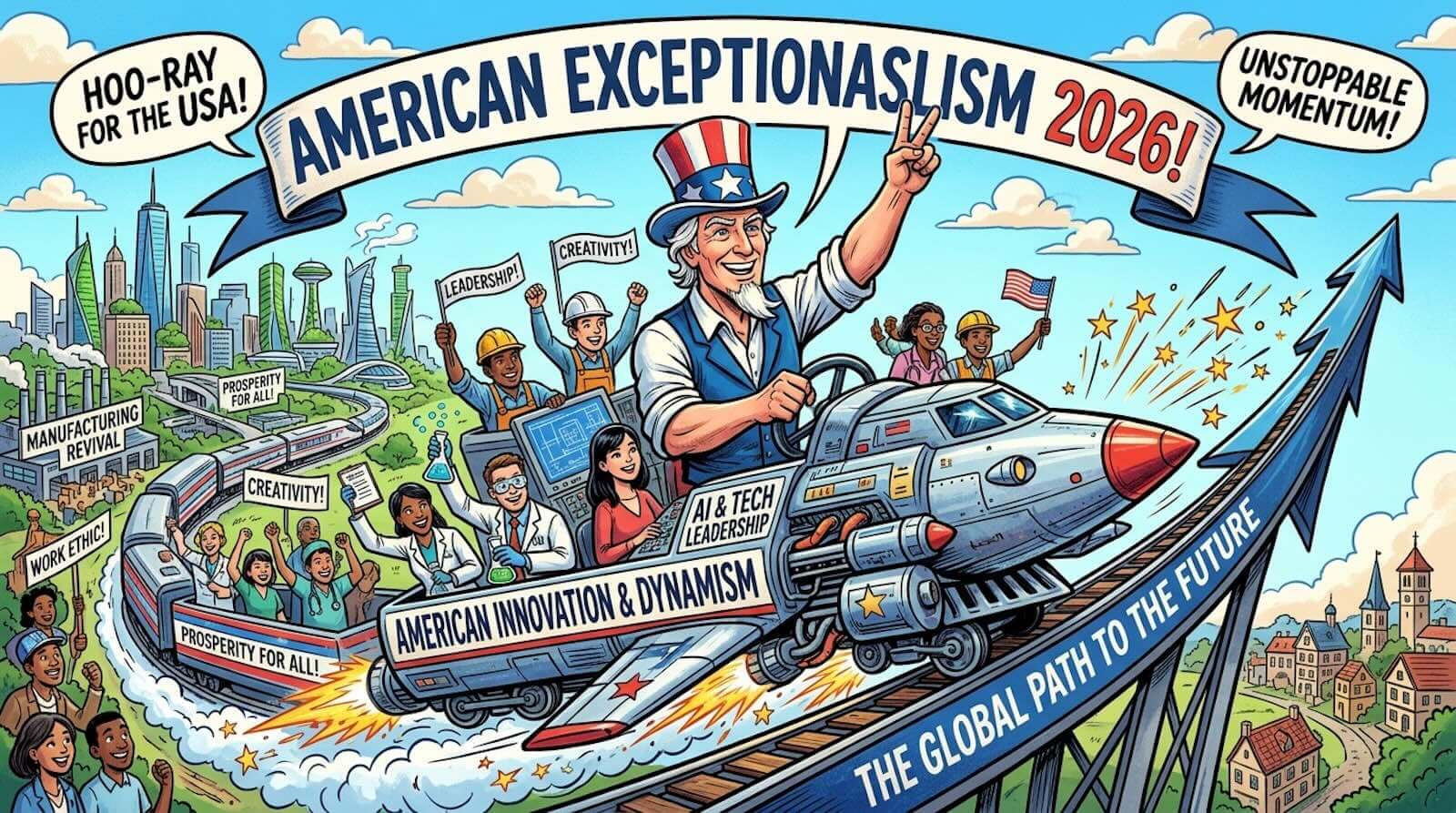
Simply put, the American economy stands without peer. The U.S. controls 78% of global AI compute power while simultaneously dominating global energy production and reserves.
American economic dynamism remains intact. A nation’s economic output is largely driven by its working-age population (ages 15–64) and its GDP per working-age person (GDPWAP) and, over the past four decades, US productivity per working-age individual has surged. Since 1980, America’s GDPWAP ratio relative to the rest of the world has grown from under 6:1 to over 8:1 (source: World Bank). The rest of the world—including China—is falling behind.
Despite China’s post-Mao progress, its GDPWAP ratio remains seven times smaller than that of the U.S. Not saying China likes being second fiddle; but, to overtake America, China’s working-age population would need to grow seven times faster than ours. Instead, China’s population is shrinking by millions annually (down 3.4 million in 2025 alone), and its fertility rate of roughly one child per woman will halve its population with each successive generation (source: City Journal).
Democratic Socialists argue that affordability would improve if America adopted European-style models like Canada, France, Germany, or Sweden. Really? Because the disposable personal incomes in those nations are 28% to 54% lower than in the United States (source: OECD). Fact: that gap has not closed since 2000—and in the case of Canada, it has widened. Why would swing voters drink this KoolAid?
In one of his earliest Sunday news show appearance as vice president, J.D. Vance asked ABC’s Martha Raddatz, “do you hear yourself?” She froze, because she realized she HAD pooh-poohed “a few” MS-13 crimes. I think that – 21 months of legacy media rooting against America and Americans – is the X-factor in these mid-terms. Because…
The press is guilty of casting DOGE as some great evil, when citizen journalists are uncovering – and juries are convicting – billions in stolen federal funds.
The press is guilty of throwing shade on the economic and military effort to prevent Iran from having a nuclear arsenal.
The press is guilty of digging in the dirt for something bad to report after the US bombed Iran’s nuclear-weapons facilities and snatched Madura out of Venezuela.
I think that media dysfunction is why veteran election-watcher Mark Halperin just said he has the least inkling ever of how a mid-term election will turn out, referring to this November. That’s a good sign because he is up to his neck in legacy news consumption. The guess here is that middling Americans will turn out in November…to vote against the boo birds, crazy socialists, and smug journalists who’d rather be right about Trump than see their fellow Americans prosper.