
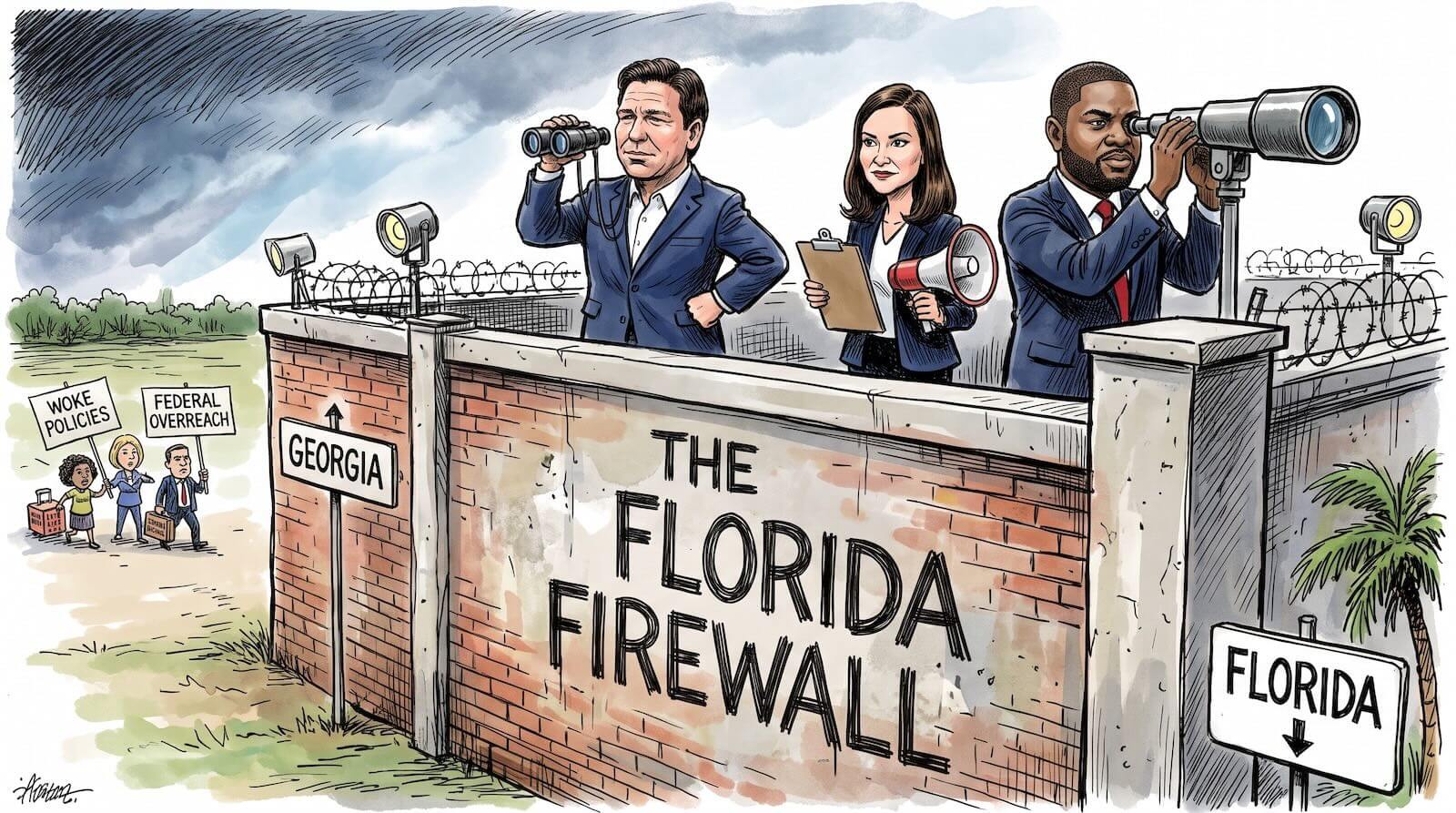
This is as close to an extinction-level event for Republicans in many parts of the country as we have seen probably in the last hundred years.
Ron DeSantis (Nov. 4, 2026)
Governor DeSantis (R-FL) can be forgiven for his pessimism (see quote above); he is, after all, testing the 2028 waters. 2026 was, in fact, less about the mood of the nation and more about turnout. Two separate studies show that over 30% of the GOP base stayed home, which is normal for most midterms. But not in 2026, when Democrats turned out in presidential-year numbers (edging out Clinton’s 2016 vote totals).
If the 2028 elections were held tomorrow, Democrats might win in a landslide. But the election isn’t tomorrow or next month. Fortunately, Republicans have two years and two clear choices: (1) run a Trump-like campaign without Trump, or (2) follow what is working in Florida. It’s a choice between bully-ball politics and mandate-fulfilling statesmanship, and the path forward should be obvious to GOP leaders. And why is that?
Because the failure to “walk the walk” after Trump-Vance “talked the talk” invited the protest vote that handed power back to the very party voters had blamed for high crime and inflation just two years earlier, right? Statesmanship, on the other hand, would have meant spending the last two years tackling the economic concerns Donald Trump promised swing voters in 2024 he would fix on “Day One.”
Talking the talk AND walking the walk is what held back the blue wave in Florida. Because Ron DeSantis, his administration, and GOP legislators worked tirelessly to deliver on the mandates voters clearly expressed in 2024, lowering the state’s cost of living, codifying popular anti-DEI initiatives, and building responsible government (more on this below).
Life After Trump
So…how did Democrats and Democrat-leaning voters end up casting 50% of all ballots, and 98% of those going to Democrat candidates? Exit polls show the GOP slipped with three key groups that, in 2024, had shifted to Trump-Vance; down 9 points with Hispanics, 10 points with Independents, and 22 points with young voters (source: Fox News exit polling).
Post-election surveys found Hispanics were angered by how Trump’s DHS operated, Independents disliked Trump’s name-calling and self-aggrandizement, and young voters blamed Trump’s tariffs for higher prices. And last week, McLaughlin & Associates’ survey pinned the GOP’s losses squarely on Trump. Only 32% of voters approved of his job performance, slightly fewer approved of his personality, and 33% of those voting for Democrats said their vote was “principally a vote against the president.”
When Trump cannot run in 2028, that’s good news. Voters have not soured on 80-20 issues like deporting criminal illegal aliens. If anything, after giving Trump the second-most popular votes in U.S. history, they soured on HOW he governed. This means the next Republican for president does NOT have to run away from most of Trump’s positions and policies…or cower before Big Media. He or she needs to be his or her own person (and tweet less).
The Florida Way
Give the Florida GOP its due. Their hard work delivered every statewide office to the GOP; held Republican majorities in both chambers of the state legislature and all 20 Republican seats in Florida’s 28-member U.S. House delegation, and passed a DeSantis-backed amendment cutting property taxes with 62% of the vote. In short, good governance begat good demographics, which begat electoral success.
Florida’s good governance began in 1924 with a constitutional amendment banning state income and inheritance taxes—the ultimate victory of the individual over the state. That amendment set the stage for the largest interstate transfer of adjusted gross income in U.S. history: $137 billion between 2019 and 2023, with roughly 85% of it coming from Democratic-run states (source: IRS). In plain English, Florida was primed to peel off tax-abused residents from blue states like New York.
And if it wasn’t abusive taxes, it was heavy-handed COVID policies that shut down schools and small businesses, or woke mandates that forced DEI programs on businesses that were already diverse and tolerant. Florida, by contrast, followed the science, limited business closures, and quickly reopened schools during the pandemic.
Further, as Governor DeSantis puts it: “Florida is where woke goes to die.” No joke, because popular anti-DEI positions became popular anti-DEI laws (e.g., barring biological males from playing girls’ sports).
Here is where it gets embarrassing for Republicans in Washington. Despite the presidency, majorities in both chambers of Congress, and a 6-3 conservative Supreme Court, they could not pass laws supported by 80% of Americans, or make a dent in the national debt. DeSantis, by contrast, cut Florida’s debt in half over his two terms while also tackling healthcare and insurance costs, increasing the property-tax exemption, and reducing fees, licensing costs, tolls, and state-university tuition.
Consider, too, that Florida’s budget is less than half the size of New York’s, even though Florida has nearly 20% more residents. So…don’t sleep on Ron DeSantis. All he did since narrowly winning his first gubernatorial race in 2018 is lead Florida Republicans from a 257,000 registered-voter deficit to a 1.5 million registered-voter advantage. The former standout baseball player did that by embracing the ultimate-competitor’s code:
“If I attack my competitor’s weakness, I can beat him. But if I attack my competitor’s strength, I can break him.”
In just four years, DeSantis broke the Democrats and the horse (identity politics) they rode in. By delivering good governance for all Floridians between his 2018 and 2022 elections, he pried two key groups away from his Democratic opponents. His party’s share of the Hispanic vote grew from 44% to 56%, and its share of the single women’s vote rose from 36% to 49% (source: AP/NORC). This, by the way, does not have to be unique to Florida.
Opportunity Knocks
Maybe a Rubio-Halley ticket would break the politics of identity once and for all, because it’s time for non-whites and women to stop obsessing over “racism” and “abortion” every election year.
Fact: the Black share of the U.S. House (13.8%) exceeds the Black share of the U.S. population (13.5%), 22 Black candidates won U.S. House races across the former Confederacy, Florida just elected its first Black governor, Georgia just elected the first Black woman governor in American history, Texas just elected its first Latina governor, and Mississippi just elected a Black U.S. senator.
Those facts add up to one big inconvenient truth for the Democrat Party: diminishing racial polarization in the South. And, with a record 138 women elected to the U.S. House, it is only a matter of time before non-whites and women recognize America’s increasingly integrated electorate. Still, getting Democrats to see the waning appeal of identity politics (when pigs fly) requires the GOP to peel off persuadable voting blocs.
Not gonna happen with African-Americans or single women with college degrees. Since 2008, Dems have won about 90% of the Black vote and 70% of the vote from college-educated single women. Dry your eyes, because that’s just 20% of eligible voters. The pot of gold is Hispanic and married/widowed voters, who comprise 75% of the US electorate (source: USCB)
Scale and momentum matters and, since 2008, Republicans have routinely won about 55% of married/widowed voters and grown their share of the Hispanic vote from 27% to 46% (source: AP VoteCast and Edison Research). So, while the mid-term losses are dismal, they don’t spell D-O-O-M for what happens two years from now.
Let’s end with a bright summation. (1) The blue wave measured Democrat turn-out, and not the mood of the nation. (2) Trump’s absence changes the emotions of 2028 immeasurably. (3) Whoever is coaching Florida’s Republicans should lead the party into 2028. (4) Hispanics and married/widowed women are the keys to breaking identity politics.
Think about that this Thanksgiving!


