
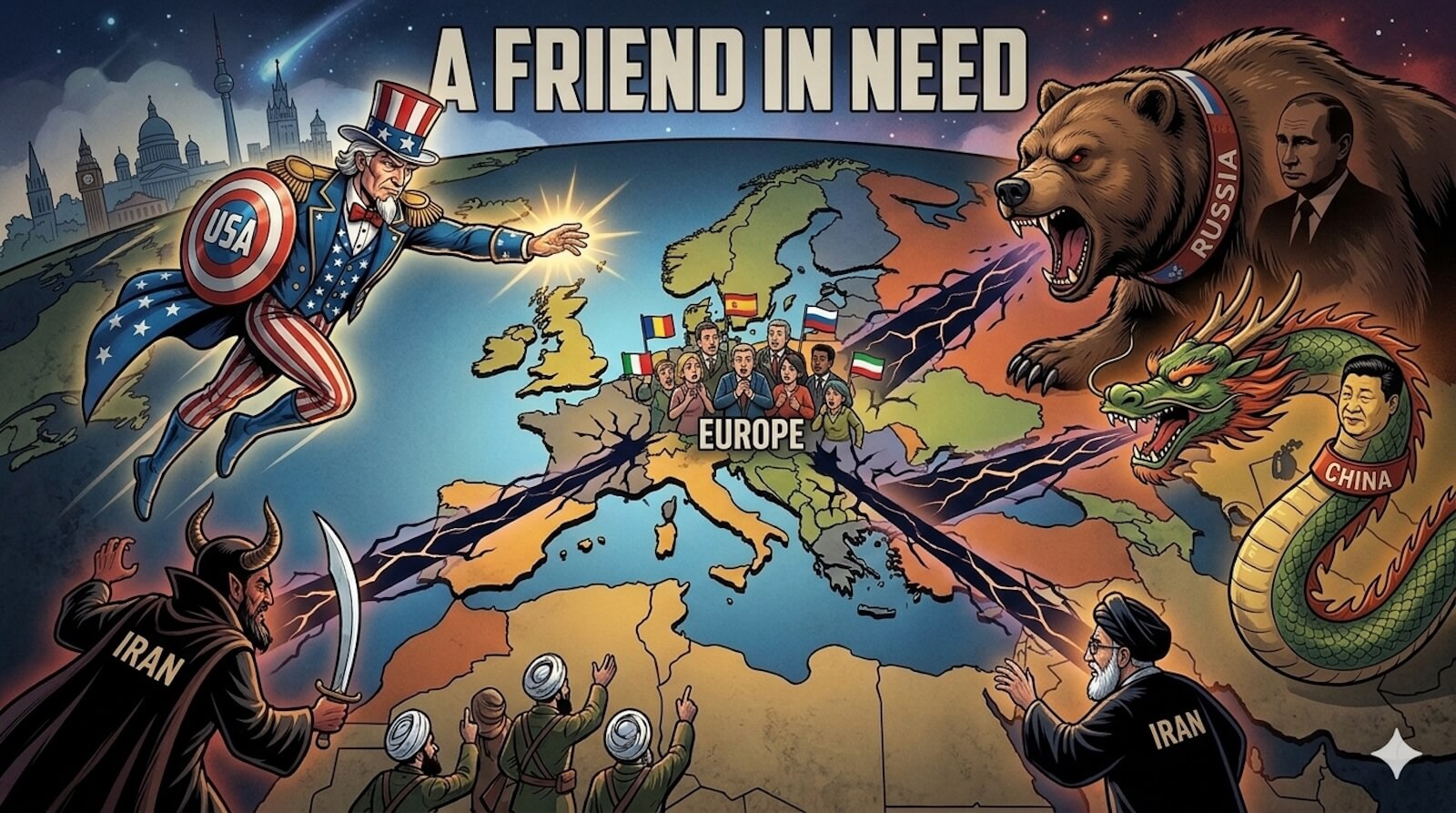
Either we fight back, or China will cripple parts of our industry. The time for naivety is over. We must defend European interests more clearly, more firmly and more consistently. We need even more protective measures.
Manfred Weber (European People’s Party)
Why does the EU keep punching below its weight? Its defense budget ($260 billion) was three times that of Russia in 2021, but that did not deter Putin from invading Ukraine. It’s China’s second largest customer, but still China responded to its trade tough talk by cancelling high-level talks two days before EU trade delegates flew to Beijing. And, despite all the US has provided for its defense, economy and energy security, the EU has provided zilch to end Iran’s quest for nuclear arms.
EU leaders bristled when J.D. Vance shamed them for abandoning the principles of the Enlightenment and Reformation, but sometimes the teacher needs to listen to its star pupil…and America is just that. The US population (340 million) is 23% smaller than Europe’s (420 million), but its defense budget ($935 billion) is 60% larger (EU = $370 billion), and its nominal GDP ($30.6 trillion) is 31% larger (EU = $21.1 trillion). No wonder Vance had the temerity to fault the EU for suppressing individual liberty and stifling local autonomy.
The Treaty of Rome (1957) created a 6-nation “common market” for capital, goods, labor and services, but the Maastricht Treaty (1993) squeezed 27 “member states” into a supranational political entity with a single currency (Euro) and one central legislative body (EU Parliament) enacting foreign trade and security policies. That bound the finances of prudent Germans to profligate Greeks, and allowed France’s immigrants (until 2016) to enter Denmark. Now, the EU (and NATO) have a lot of catching up to do.
NATO Freeloaders
Europe has long been protected by the US-funded NATO umbrella; according to the IMF, America’s 2020 defense budget ($778 billion) dwarfed that of the EU ($225 billion). That disparity allowed Europe to spend more on carbon-free energy and entitlements, without paying to defend its energy supply chain. And, even after Russia invaded Crimea (2014), Europe went ahead with the Gazprom pipeline deal (2015), ignored Trump’s defense-spending pleas, and was (wrongly) relieved by his re-election loss…
…because Iran re-entered the nuclear-arms race, and Russia invaded Ukraine, inviting a told-you-so moment for Trump after his re-election. He shifted America’s NATO role from a free security blanket to a transaction-based partnership, and forced Ukraine to re-invent its defense; resulting in higher EU defense spending, and NATO realizing drone teams and ground robots can defeat “big power” armored and infantry divisions. And, after Iran closed the Strait of Hormuz, America’s so-called allies got exposed; the EU accepted higher energy costs, rather than enforce UN articles (38 and 44) of international maritime law.
The EU’s NATO members need to re-watch the Dirty Dozen and reflect on Major Reisman’s (Lee Marvin) ask of parading soldiers: “They are very pretty, Colonel, very pretty, but can they fight?” Because, if Europe’s military cannot – or will not – fight, then its $416 billion in defense spending and 1.4 million active military personnel won’t deter Russia or Iran. That reality invited a US president’s scorn (deservedly, after Starmer bleated, “The United Kingdom played no role in these strikes”).
Double-Standards Protectionists
The macro-problem is that America protects and Europe profits; because, when the US pushed the EU for a trade re-set, the Europeans rejected “fairness” as an issue. They argued the EU’s ten-year $1.5 trillion trade surplus with the US was due to high US consumer demand for “superior” European goods, blamed health and safety concerns for restrictions on US agricultural products, and ran to the WTO the minute Trump used tariffs to force reciprocity. Meanwhile, the ten-year imbalance in US-EU defense spending was $5.6 trillion (source: EU Parliament Research). Not much of a “friend” or “ally” in my opinion.
Fact: until Russia invaded Ukraine, the EU bought a measly $19 billion in US oil and gas annually. That jumped to $74.7 billion last year, when the EU also agreed to buy $750 billion in US energy products from 2026-2028. And after Iran disrupted the Gulf? The EU’s share of US oil exports jumped to 47%. And is the EU grateful? Not when its officials now bemoan the “long-term geopolitical risks of an over-reliance on a single Western supplier” (source: IEEFA). Mind you, the same folks insisting the US recognize “the rules-based global order” in trade gave Iran a pass.
That’s the same brain trust that increasingly relied on clean-energy generation (from 760 TWh to 1,980 TWh since 2005) that now relies on China for 75% of its solar components, lithium-ion batteries, and wind turbines. With the EU’s green infrastructure held hostage…well…when the EU declared its “economic relationship with China was unsustainable” – citing a daily trade deficit of $1.2 billion – Beijing responded with the aforementioned trade-meeting cancellation (source: Financial Times).
The Institute for Policy Studies Jianlu Bi explains China’s position: “when Europe exports billions in luxury vehicles and machinery, it is heralded as a triumph of comparative advantage, but when China leverages its unparalleled infrastructure to manufacture 30 per cent of the world’s goods, European demagogues label it a predatory threat.” No question, assuming the US would always make “bad trade deals” and China would remain a “low-tier assembly line” has backfired.
No joke, because (like the US) China recognizes “double-standards protectionism” when it sees it. Just last week, the Chinese trade ministry told the South China Morning Post the “narrative spun by Brussels is a desperate attempt to weaponize trade policy to mask structural, self-inflicted failures.” Ouch!
Out of Touch Politicians
Vice President Vance rightly called out the “threat from within” Europe; specifically, the retreat from its own core civilizational values. He explicitly warned EU leaders that digital censorship of alternative views, mass immigration, and suppressing populist voters are destroying European democracy far more than Russia or China. Europe’s ruling elites had better listen, because the center of gravity in Europe is decidedly moving rightward, with only 7 securely-liberal governments (e.g. Spain).
That leaves 12 securely-conservative governments (e.g. Italy) and 8 leaning-conservative governments (e.g. Germany), because of deep voter frustration. Lower GDP growth rates and higher costs of living have created widespread economic anxiety. Green fatigue has set in amongst rural and industrial workers. Native-born Europeans are angered by growing numbers of immigrants who refuse to assimilate. Thus, the ascent of the right-wing Alternative for Germany (AfD) is worth un-packing.
In February 2025, it won 20.8% of the popular vote in a national election. Then, in May 2025, it was upgraded to a “confirmed right-wing extremist endeavor” by Germany’s domestic intelligence agency (the BfV). Fast forward: Chancellor Friedrich Merz’s centrist coalition has NOT lowered unemployment (now 6.8%) or petrol prices (up 26.2%). It has not addressed immigrant crime in Bavaria, Berlin and Baden-Württemberg, where immigrants are 15% of the population and 50% of the crime (source: PKS). Today, the AfD at 29% approval is polling ahead of Merz’s party (source: INSA).
J.D. Vance does not need a weatherman to know which way Europe’s political winds are blowing, because recent polls show 69% of Brits don’t approve of Keir Starmer, 80% of French aren’t satisfied with Emmanuel Macron, and 86% of Germans are dissatisfied with Friedrich Merz (source: YouGov and Infratest Dimap). Still, these men bow to the European Union.
So…yeah…Vance schooled the EU…but did they learn a thing?