
The idea that this President is going to somehow agree to a deal that ultimately winds up putting Iran in a stronger position when it comes to nuclear ambition is absurd.
Marco Rubio, Secretary of State
The commentariat is mostly wrong about Iran because they’re outside the tightest inner circles in Tehran and Washington doing the negotiating (I get my breaking news from Iran International; mostly posturing from both sides on social media). Against that backdrop Friday, the White House released a synopsis of a realistic peace plan. Iran will (1) allow unrestricted access in the Strait of Hormuz, (2) not develop or buy a nuclear weapon, and (3) negotiate an end to the Israel-Hezbollah war in Lebanon. The US will (1) lift its blockade and allow Iran to sell oil, and (2) “discuss” humanitarian aid and goods for Iran.
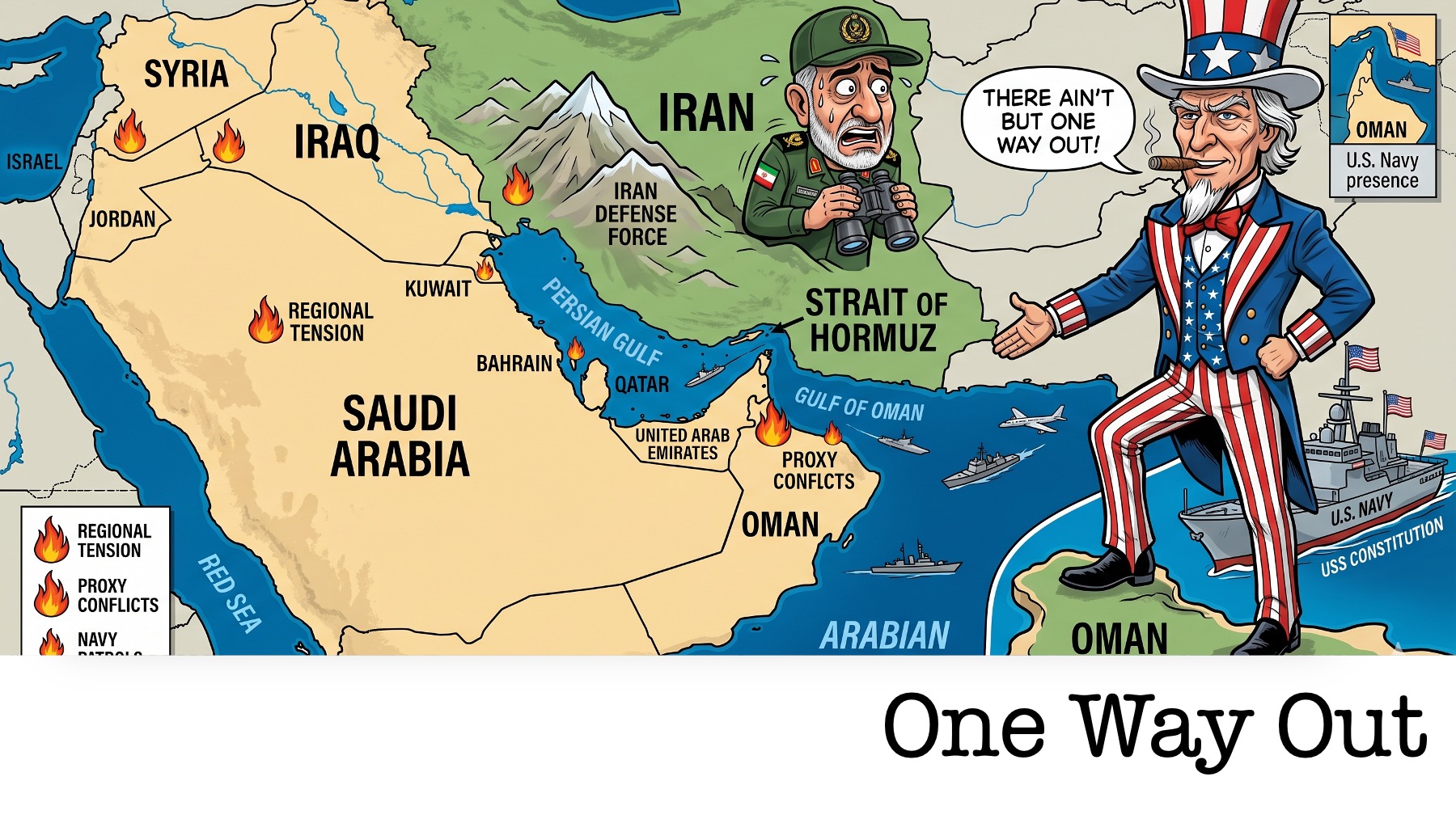
There is a future perfect vision for the Middle East that looks like economic assistance for the Iranian people, predictable oil and gas prices for Asia and Europe, and peaceful coexistence in the region. There ain’t but one way out. Because, if war returns, Iran will be the nail, the USA will be the hammer, and energy prices go up. That’s why the President’s pushing every Muslim nation to sign the Abraham Accords, including Iran. To be sure, his idea is aspirational, but it’s not unhinged.
In the 47 years since the Islamic Revolution in Iran, the Middle East has been constantly in the news for all the wrong reasons, and the world has grown exasperated. The EU, NATO and UN now sit on the sideline; too frightened to help, but secretly rooting for this US president to succeed. There’s but one way out for the Middle East, and it is NOT a nuclear-armed Iran or the US funding another forever war.
The end of internet restrictions in Iran has released a tidal wave of anger about inflation from ordinary Iranians, who report price increases of over 150% for food staples like chicken and rice. This has been corroborated by data from the IMF; i.e. food inflation between 140% and 200% has pushed overall inflation to 70% (source: The Guardian). This is how opting for “Death To America” in 1979, instead of joining Pax Americana, has sent Iran down the road to ruin. Because America has always been willing to ensure prosperity in exchange for peace.
After WWII, the Marshall Plan turned vanquished Germany and Japan into the world’s 3rd and 5th largest economies. The US allowed China into the WTO in 2001; thereby allowing the communist nation’s export economy to grow from $1.2 trillion to $18.3 trillion. Former enemy Vietnam’s GDP was $2.5 billion in 1979, but it now exports $153 billion annually to the US. In contrast, Iran’s exports to the US since 1979 have shrunk by more than 99.9% to $1.4 million (source: Trading Economics).
The Islamic Revolution invited an economic disaster, with Iran’s GDP rank falling from 21st in 1979 to 40th in 2025, and its median individual incomes falling from 45th in 1979 to 135th in 2025 (source: IMF). That did not have to happen, because other comparable nations have flourished since 1979; for example, Saudi Arabia, Vietnam and North Korea. The tables below contrast these three countries’ national and per capital GDP with Iran’s at the time of the Revolution (1979) and most recently (2025). Important, because these three economies are deeply entwined with the US, while Iran is not.
| NATIONAL GDP | ||||
| ANNUAL GDP (US$) | GLOBAL RANK | |||
| 1979 | 2026 | 1979 | 2025 | |
| IRAN | $90.4 Billion | $341 Billion | 21 | 40 |
| SAUDI ARABIA | $113 Billion | $1.27 Trillion | 15 | 19 |
| VIETNAM | $2.5 Billion | $485 Billion | 105 | 34 |
| SOUTH KOREA | $65 Billion | $1.87 Trillion | 28 | 13 |
Since 1979, South Korea’s GDP has grown by $1.8 trillion, Saudi Arabia’s by $1.2 trillion, Vietnam’s by $482.5 billion, and Iran’s by just $250.6 billion. Historically, 80% to 90% of Iran’s exports have been oil and gas; 5.5 million barrels of oil per day in 1979, but only 2.8 million barrels today. Clearly, Iran’s quest for nuclear armaments has not been worth the cost of American trade sanctions, especially in contrast to Vietnam and South Korea.
Vietnam’s economy languished until 2007, when it was granted Permanent Normal Trade Relations with the US, its largest export customer today. South Korea has thrived despite its nuclear-armed rival to the north. And, while Iran was doing an economic belly-flop, the global economy never even hiccuped; growing from $10.1 trillion in 1979 to $110 trillion last year (source: IMF). Sadly, the damaged party is Iran’s own people, whose personal incomes have stagnated in comparison to the Saudis, Vietnamese, and South Koreans (table below).
| PER CAPITA GDP | ||||
| HOUSEHOLD INCOME (US$) | GLOBAL RANK | |||
| 1979 | 2025 | 1979 | 2025 | |
| Iran | $2,352 | $3,700 | 45 | 135 |
| Saudi Arabia | $13,200 | $35,460 | 15 | 35 |
| Vietnam | $60 | $4,745 | 140 | 125 |
| South Korea | $1,750 | $36,300 | 60 | 30 |
Saudi Arabia’s widening per capita GDP advantage over Iran – from $1,348 in 1979 to $31,760 last year – is evidence aplenty that the Ayatollah has failed his people. And all war-torn Vietnam did was forgive the USA and ignite its household incomes, exploding past Iran. Meanwhile, South Korea went from trailing Iran by $602 to its tenfold advantage today, primarily by exporting to the US. Iran should recognize that Saudi Arabia has honored its Muslim faith AND traded with the USA, and South Korea has thrived without the protection of nuclear-armaments.
The view here is that Iran’s quest for a nuclear weapon has been its undoing. They have fallen behind the non-nuclear Saudis, Vietnamese, and South Koreans. And, if a nuclear weapon is so great, why do the per capita GDPs of nuclear India, Pakistan and North Korea rank 140th, 160th, and 175th, but the per capita GDPs of non-nuclear Singapore, Ireland, and Switzerland rank 2nd, 3rd and 4th (source: IMF)? A nuclear weapon is meant to protect a nation’s people, not strangle household incomes and ruin global trade relations (so bad now that Iran sells 90% of its oil and gas exports to China at below-market prices).
The IRGC could have learned from Vladimir Putin (who claimed he’d “fully subjugate” Ukraine’s government in 10 days) that kinetic wars are too costly and unpredictable. They can hope the US has strategically miscalculated, but that burden is actually on the Islamic regime that’s prolonging the agony of a crippled economy, domestic instability, and weakened military. The conflict with Iran is a reminder that structural advantages matter. Washington holds the economic and military hammer—and Tehran is holding on for dear life.
Nowhere is this asymmetry clearer than in the global energy market, where Iran is losing the economic war. Its aggressive tactics in the Strait of Hormuz triggered the ultimate geopolitical backfire. By forcing volatility into Middle Eastern shipping lanes, Iran didn’t cripple the West—it just accelerated America’s march toward total energy dominance. In the arithmetic of global trade, the world’s largest oil and gas importers demand predictability, safety, and scale – and US energy exports have surged to fill the global vacuum.
Total US exports of crude and refined petroleum products recently hit a record 12.9 million barrels per day. European nations have doubled their import of US jet fuel to an all-time high. Greece is buying US oil and gas for the first time. The US has further expanded its strategic “energy advantage” by exercising strict control over Venezuela’s oil and gas trade. In short, all signs suggest Iran’s regional sabotage has inadvertently served as a marketing campaign for American energy dominance. Which is why Iran is on the clock.
Its only export is oil and gas related, continued war can destroy that infrastructure, and lost customers are unlikely to return. Maybe it will take another 60 days, but there ain’t but one way out for Iran.
Take the deal.