
The idea he’d strike a bad deal for the American people is preposterous. He is the person who had the courage to fundamentally transform our relationship with Iran and with a lot of other countries over the last year and a half.
J.D. Vance (on President Trump)
Imagine the “peace dividend” from a US-Iran agreement. Less government spending. Lower gasoline prices. What don’t Senate Boo-birds Kaine (D-VA) and Cassidy (R-LA) like about that? One does not have to be enamored with Trump to acknowledge that he created an opportunity for a peaceful Middle East; having done more to secure Israel, befriend the Arabian Peninsula, and weaken Iran than presidents Bush, Obama or Biden. That record should invite our patience with how he wields hard power.
To be sure, he does not walk softly, but that “big stick” has forced Brussels to lower duties to 0% on most US imports, rescued Venezuela from narco-despot Maduro, and taken out 48 senior Iranian leaders in Tehran. Kaine and Cassidy claim the US-Iran peace process won’t result in something akin to the 1979 Egypt-Israel Peace Treaty, but shouldn’t their humanity move them to give peace a chance? Yes, and the Vice President explained the “memorandum of understanding” (MOU) on Thursday.
The MOU is a quid pro quo exchange between Iran and the U.S and its allies on the Arabian Peninsula, requiring Iran to demonstrably modify its behavior to recoup its losses and resume oil exports. The U.S. alliance has a 3-part vision: Iran cannot (1) have nuclear arms, (2) threaten navigation in the Gulf or Strait, or (3) fund terrorist proxies. Skeptics doubt the world’s #1 sponsor of terror will ever agree to terms with the US, but conditional surrender beats their current bad situation.
Conditional Surrender Beats Continual War
How bad is it for the regime? Add in Israel’s spies and America’s Space Force knowing everything going on inside Iran. Subtract a military and economy ruined by over 29,000 precision and non-precision munitions in a five-week period. Its Air Force and Navy are mostly destroyed (source: Iran International). Its currency is devalued by 97% (source: Al Jazeera). Its oil exports dropped to zero (source: FDD). Its monthly GDP has dropped by $13 billion, and the consumer inflation rate is 68.9% (source: IMF).
Anyone believing that’s “survival” is living in Bizarro World. Or maybe they are, as J.D. Vance observed, people “who want the conflict to continue indefinitely, despite the fact that’s not good for the American people and not good for the region.” What the MOU describes is a “conditional surrender” by Iran to avoid annihilation of the Islamic Republic and innocent Iranians. It’s folly for hawks to fault the quid pro quo terms because “unconditional surrender” is not realistic.
There is a reason that no G7 nation, since World War II, has ended a war by forcing “unconditional surrender” on its enemy (look it up); advanced civilizations don’t want the consequences of dropping A-bombs on civilians (Japan) or reducing major cities to rubble (Germany). In a 24-7 news world – with over a billion smart phones – no US president is going to kill 2,000,000 innocents (Germany and Japan’s non-combatant death toll) to kill Iran’s nuclear ambitions. The optics are too awful to consider.
Total subjugation leading to unconditional surrender is not a modern reality, starting with Iran’s alliance with nuclear-armed China and Russia. That’s too risky, and demanding unconditional surrender gives the radical Islamist regime inside Iran no incentive to surrender. And, in the era of asymmetric warfare, getting a non-state actor (Hezbollah) or unstable regime (Iran) to execute a binding, top-down national surrender is almost impossible. Which is why international law and the UN heavily favor negotiated ceasefires and peace treaties.
This conflict was always going to end with a “term sheet” agreeable to both sides, and there is a glimmer of hope. On Thursday, the supreme leader’s family told Iran International that Mojtaba Khamenei favored “establishing political and commercial relations” provided Washington “treats Iran respectfully.” On Friday, Al Arabiya corroborated; reporting that Khamenei had, after receiving assurances, agreed to the MOU: “From this moment, we — you, the proud nation, and this humble servant — will await the realization of the stated conditions.”
After urging “death to America” for 47 years, for Iran’s supreme leader to now urge Iranians to “await the realization of the stated conditions” is good news. And, for every boo-bird griping about the “$300 billion” cited in the MOU, remember that America’s “war on terror” cost US taxpayers $8 trillion (source: Carnegie Corporation). Hmm…$300 billion to avoid nuclear war, lower the world’s energy prices, and reduce terrorism…let’s talk about it.
Weaponizing Energy Dominance
Don’t look now, but President Trump has weaponized energy dominance – surpassing both Saudi Arabia and Russia – to dictate global supply parameters, absorb international market shocks, and financially starve adversaries while directly reducing the domestic trade deficit. Who knew the new “Golden Age of America” would turn the global economic system into a zero-sum arena dominated by American market leverage (i.e. forcing trade partners to renegotiate terms under the immediate threat of economic isolation)? Controlling Venezuelan and Iranian oil exports is just part of the hard-power calculus.
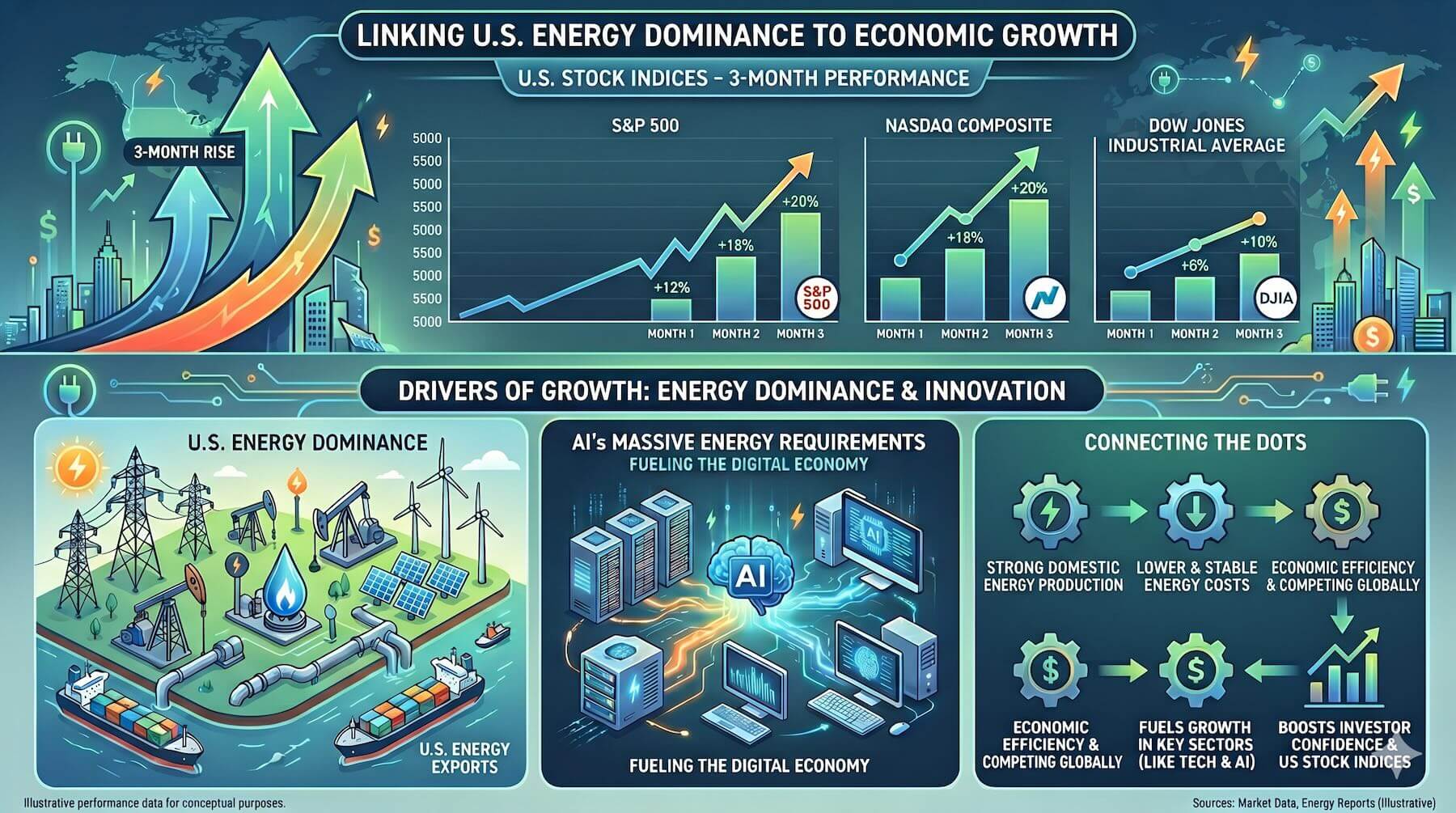
Trump has used “hard power” to lower the US trade deficit from $945.3 billion (2022) to an estimated $680 billion this year; currently averaging $56.1 billion per month, the lowest since 2019, resulting in a lower net flow of capital out of the US economy (source: BEA). And, nowhere is “hard power” more consequential than the energy sector, where the US is now the world’s top exporter of oil and refined products (source: Energy News Beat). The big story in 2026 is the “energy independence” pledge from 2016 (protect the US from OPEC) is now “energy dominance.”
Big, because the next Industrial Revolution will be driven by AI (artificial intelligence), requiring a 33% increase in global energy by 2036 (source: The Brookings Institute). That’s an increase from 31,000 to 42,000 Terra-watt hours (TWh) in electricity generation/demand, which is why Silicon Valley dumped Democrat Harris for Republican Trump in 2024. They knew AI would create an economic wave larger than all others, and meeting AI’s energy needs required carbon-based fuels. With more than $2.5 trillion invested in the sector in 2026, they bet on the right horse.
The final piece of the energy puzzle is eliminating the “instability cost” that’s been baked into every barrel of oil since the 1970s OPEC embargoes. To wit, the price of benchmark Brent oil spiked from $60 per barrel in early January to $118 in April, because of Iran (source: Goldman Sachs). Even now, at $76 per barrel, Rystad Energy Analysts predict a $5-10 “geopolitical risk premium of $5-10 per barrel (through) January.” And THAT is why the EU, India and Japan have committed to massive US energy purchases, and monthly US exports of oil and gas are now setting record highs (source: CNBC).
Trump has his faults, but he does have a keen eye for momentum and opportunity, and he’s quickly linked Energy Dominance and America First, and the markets (see above charts) seem to agree: America is the antidote to that instability premium – – and that is just so Trump.
If Iran does not get this, and agree to terms, they’re misreading the moment at their own peril. Hmm…another 29,000 bombs and missiles…or peace…choose wisely, humble servant.