
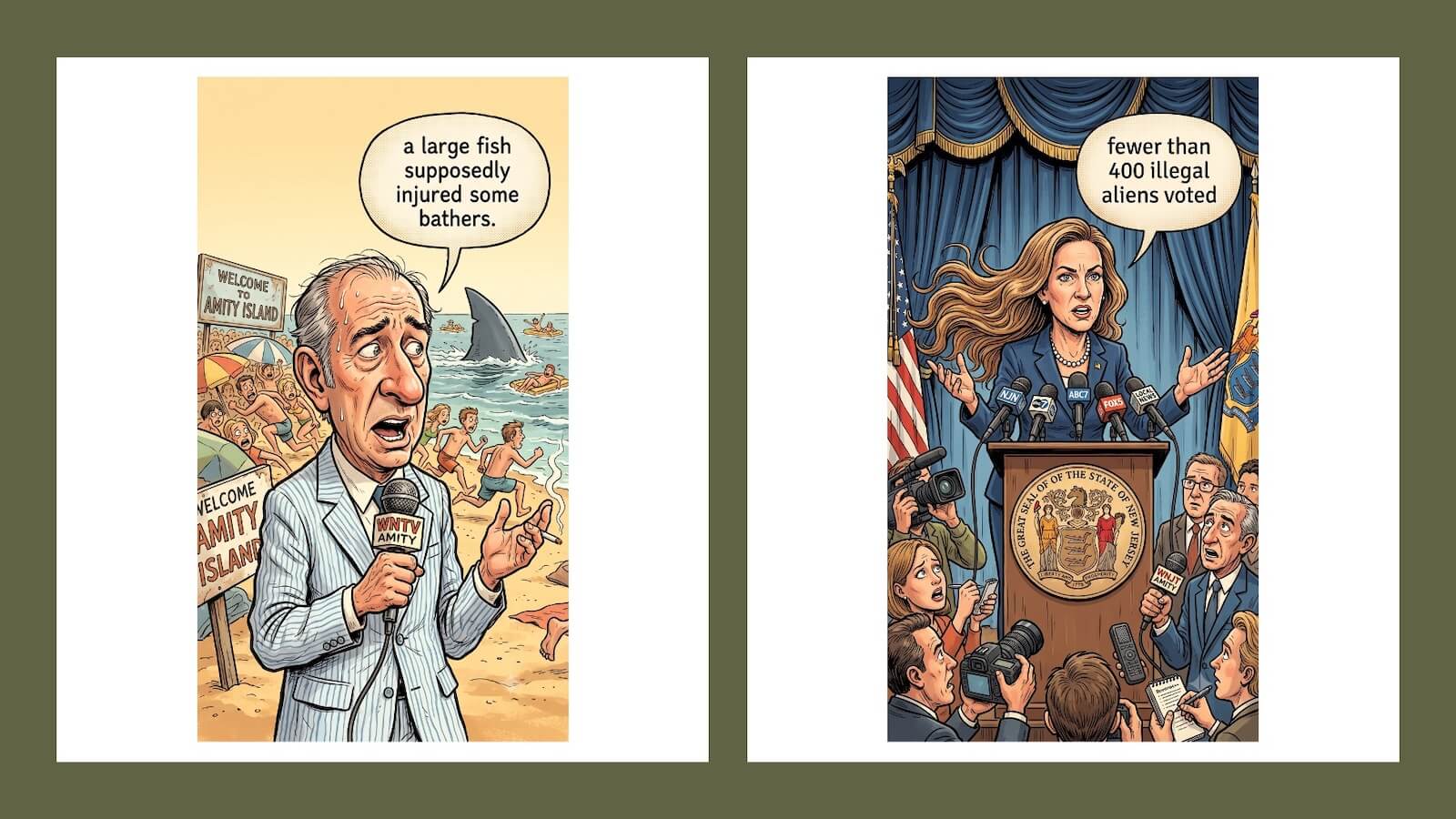
A process that was sound yesterday can still yield unacceptable defect rates today. The only acceptable number of non-citizens on an American voter role is zero.
Rep. Tony Wied (R-WI)
If you think 400 illegal votes don’t matter, history says otherwise.
In 2000, 537 votes in Florida decided the American presidency. In 2004, Christine Gregoire won the Washington governorship by 129 votes. In 2008, Al Franken secured a Minnesota Senate seat by 312 votes—handing Democrats the 60-vote, filibuster-proof supermajority needed to pass Obamacare.
Massive policy shifts and Supreme Court appointments do not require landslide victories; they hinge on a few hundred ballots. Which brings us to New Jersey, where state officials recently acknowledged that a software glitch improperly registered 6,600 noncitizens to vote—and that nearly 400 invalid ballots were cast before anyone caught it.
Despite a failure large enough to swing a close election, Democratic leadership brushed it off as a harmless administrative hiccup—fitting neatly into a decade-long pattern of dismissing election-integrity warnings.
In the U.S. Senate, the Democratic strategy has relied on two predictable talking points. First came the flat denials: Chuck Schumer (D-NY) declared, “The evidence is that almost no illegal immigrants vote,” while Mark Kelly (D-AZ) told reporters, “There’s no evidence that undocumented immigrants vote.”
Then came the dismissals of the SAVE Act’s sponsors. Dick Durbin (D-IL) claimed, “The SAVE Act attempts to solve a problem that does not exist.” Bernie Sanders (D-VT) echoed, “We’re debating a problem that does not exist.” Raphael Warnock (D-GA) called it “a solution in search of a problem.”
In short: This doesn’t happen—and even if it does, it’s too rare to matter.
New Jersey Governor Mikie Sherrill dismantled that narrative in a single press conference. What remained was pure political spin—worth examining just as closely as the underlying facts.
Sherrill’s Inconvenient Truth
When Governor Sherrill’s administration confirmed that a software glitch in the Motor Vehicle Commission system (operated by vendor Idemia) registered roughly 6,600 individuals who had explicitly checked “No” to citizenship, the “it never happens” narrative collapsed. The automated glitch ran uninterrupted for a full year—from June 2023 to June 2024.
Sherrill emphasized that “fewer than 400” of those improperly registered noncitizens actually cast ballots. But in an era where major races are routinely decided by fractions of a percentage point, 400 illegal ballots are not a rounding error. They are potential outcome-changers.
Furthermore, those figures represent only what New Jersey has publicly acknowledged. Department of Homeland Security (DHS) data suggests 35,152 noncitizens remain on New Jersey’s voter rolls alone, contributing to an estimated 250,000 across four key states (New Jersey, California, Nevada, and Pennsylvania). Independent reporting from The Hill has already matched over 118,000 of those DHS records directly to confirmed noncitizen files.
If an enterprise software bug mistakenly granted 6,600 unauthorized users access to sensitive defense data for 12 months, the C-suite would be dismantled overnight. Yet inside state election infrastructure, we are told it is a non-issue.
Let Them Eat Spin
Governor Sherrill’s official response offered a masterclass in crisis management—managing a bad headline rather than addressing the core failure:
-
The Soft-Pedal: “Through no fault of their own, the system registered them anyway.” This absolves noncitizens while neatly obscuring government liability, scattering blame across code, vendors, and prior administrations.
-
The Pivot: “Donald Trump has zero credibility on the issue of election integrity.” Deflecting to a political opponent does not fix a confirmed system failure inside her own state. It simply flips the script to partisan distraction.
-
The Retroactive Shield: “We don’t hide it, deny it, or invent conspiracies.” This praises post-hoc disclosure while ignoring the 400 invalid ballots already counted. A safeguard that only triggers after an illegal vote hits the box isn’t a safeguard.
Sherrill blamed Idemia’s software; Idemia countered that its role was strictly to transmit raw data, leaving verification to the state. But both agree on the core vulnerability: an automated pipeline made eligibility determinations for a full year without a single human validation step.
This validates the exact warning critics have voiced: election infrastructure contains systemic, unmonitored blind spots.
Continued Improvement Made US Great
In the private sector, no organization treats “good enough” as a final destination. Manufacturers run Six Sigma and Kaizen programs because a sound process can still yield unacceptable defect rates. Software companies patch vulnerabilities. Financial auditors re-test internal controls. Demanding that a system continuously improve is standard quality management, not an insult to the factory floor.
American election law has historically followed that exact logic:
-
Late 18th Century: States moved away from voice-voting at open tables toward paper ballots.
-
1993 (NVRA / “Motor Voter”): Streamlined registration by linking it directly to state DMVs.
-
2002 (HAVA): Mandated centralized state voter databases following the 2000 “hanging chad” recount.
Each reform treated system maintenance as standard practice: proof that today’s safeguards can be made stronger tomorrow.
The SAVE America Act sits squarely in this lineage. By amending the 1993 NVRA to require documentary proof of citizenship when registering and photo ID when voting, it closes a critical verification gap created by the Supreme Court’s Arizona v. Inter Tribal Council of Arizona ruling. Treating this specific proposal as uniquely sinister—when it is simply the latest entry in a 230-year tradition of administrative updates—is where the opposition’s argument stops being honest.
No SAVE = No Mandate
To scoff at “400 individual ballots” is to ignore how modern politics operates. Once a candidate is certified—whether by 129 votes or 537—the winning party instantly claims a broad, unchecked mandate. Functional ties are treated as ideological landslides, used to ram through sweeping legislation, judicial nominations, and systemic policy changes.
When razor-thin margins yield absolute power, every invalid ballot becomes an existential threat to government by consent of the governed.
Arguing that nothing needs to change in a state where the election apparatus failed undetected for 365 days isn’t just poor administration—it is pure intellectual dishonesty. It calls to mind Mayor Vaughn’s infamous line before the news cameras in Jaws:
“I’m pleased and happy to repeat the news that we have, in fact, caught and killed a large predator that supposedly injured some bathers.”
We all remember how that worked out for the town of Amity (queue the ominous cellos).