
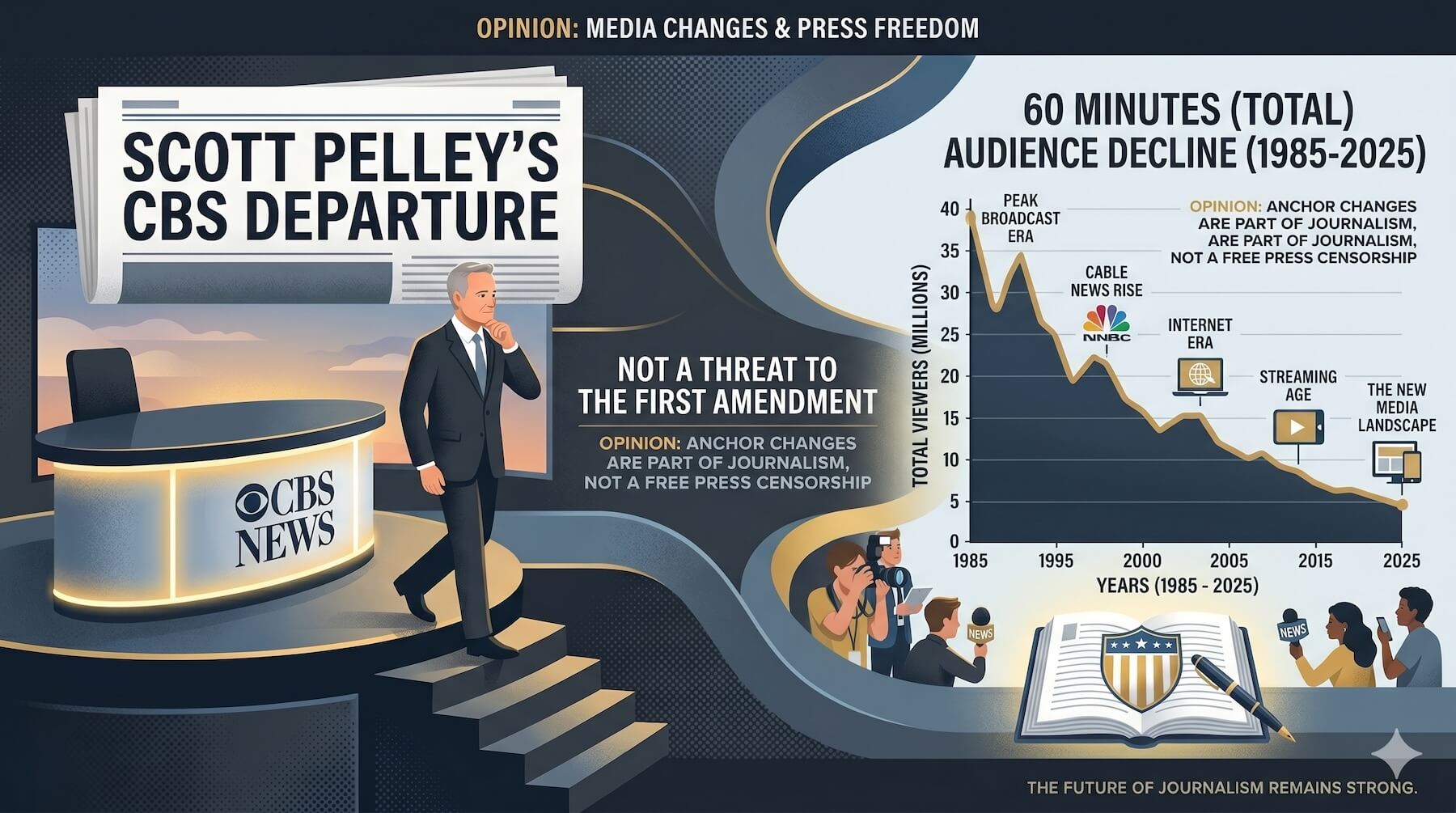
Like every industry, America’s “free press” must turn a profit to keep the lights on, and that’s a problem at CBS’s 60 Minutes. Long the gold standard of investigative journalism, it’s now a case study in the agonizing balance between editorial independence and corporate interest. Are journalists only accountable to the truth, and does the first amendment prevent producers and publishers from limiting political bias? No, and with citizen journalists everywhere, big media can only survive by appealing to the widest possible audience and making prudent business decisions.
Did you know that before 60 Minutes debuted in 1968, network news divisions operated at a loss? True, because television networks like CBS viewed unprofitable news programming as the price of admission to satisfy the FCC’s public service requirements. Then, Don Hewitt, CBS’s legendary producer, shattered that model by framing investigative journalism through a narrative lens with 60 Minutes. His simple yet revolutionary change (i.e. stop covering abstract issues and start telling stories about the people swept up in them) turned news into appointment viewing.
By proving that great journalism could be highly profitable – 60 Minutes hit number one in prime-time ratings by the late 1970s at costs significantly below scripted dramas or sitcoms – Hewitt created industry expectations that all divisions can make money; thereby shifting the metrics of success away from pure civic utility toward viewership and demographic pull. Last week, those metrics got veteran journalist Scott Pelley fired from CBS News; exemplifying today’s existential clash in journalism.
Media stars can adapt to corporate restructuring and changing editorial standards, but not Pelley; he chose his new boss’s (60 Minute’s executive producer Nick Bolton) first staff meeting to tell co-workers that “incompetence and unprofessionalism in the new management have wreaked havoc” and that Skydance (CBS’s new owner) had brought in Bari Weiss (CBS News editor-in-chief) to “murder 60 Minutes.” In the turnaround world, that made Pelley the “don’t be this guy” example a new leader has to terminate and, one day later, he was fired “for cause.”
The problem Skydance Media found at CBS and CNN is the same problem Versant Media found at MSNBC, Dr, Patrick Soon-Shiang found at the LA Times, and Jeff Bezos found at the Washington Post; entrenched journalists think down-sizing is the end of the world, and checking anti-GOP bias is a “free press” violation. That’s why Skydance brought in former New York Times opinion editor Weiss to re-invent CBS News after paying $8 billion for CBS’s parent company, Paramount Global – and why Pelley was viewed as part of the problem.
In his firing memo to Pelley, Bilton wrote, “you hijacked my first meeting with staff to disparage me, my qualifications, and my intentions with remarkable incivility and contempt (in a) performative display of hostility (showing) no interest in contributing to the future success of the show” (source: Washington Post). And, on Wednesday, Weiss told remaining employees that she was “only interested in working in a newsroom that is built on trust and mutual respect. We cannot do our work without it. That foundation was broken Monday” (source: LA Times).
In response, Pelley says he was ordered to “inject falsehoods and bias into a politically sensitive story…to curry favor with the Trump administration” (source: Forbes). Yikes! And he claims “good people were silenced because they stood for fairness against the forces of political bias” (source: The Guardian). Those principles cost Pelley $7 million a year, which did not impress veteran journalist Britt Hume: “the correspondents at 60 Minutes, led by Pelley, seem to think they are the guardians of journalistic integrity.”
Hume, who’s “worked in this TV news business (for) many different bosses” has survived “for more than a half century” because he “found a way to work with every one of them as best I could.” He advises his industry peers to be “open to the ideas of others with whom (you) might at first disagree (and) remember in life that the boss is still the boss” (source: Fox News). Pew Research found that 60% of Americans retire without ever being “fired for cause” and I’ll bet those folks agree with Humes’ “the boss is still the boss” comment – and that’s the REAL story here.
Pelley created “the cause” by creating the “havoc” at 60 Minutes before Bilton had even produced his first show; thus, it’s a thinking trap to ignore Pelley’s personality (acting out in his boss’s first staff meeting) and question only Bilton’s and Weiss’s journalistic integrity. Because, from a strict legal standpoint, Weiss and Bilton did not threaten “free speech” by insisting on “both sides” journalism. The first amendment explicitly states Congress shall make no law to shield against government censorship and regulation…not to stop corporations like CBS from doing an editorial re-set.
In the landmark Supreme Court case Miami Herald Publishing Co. v. Tornillo (1974), the Court ruled the government cannot compel a private publication to print content it does not want to run. The choice of material and editorial treatment are protected exercises of journalistic judgment. CBS, in fact, exercised this judgment in 1995, when it delayed the tobacco whistle-blower story on 60 Minutes due to fear of a multi-billion dollar lawsuit.
60 Minutes has fallen from 23.9 million viewers in 1985 to 9.1 million last year (source: Nielsen Media Research). Most CEOs would respond to that by cutting costs and appealing to new customers, and urge their “stars” to be part of the solution. And, because CBS paid $16 million to settle President Trump’s “political bias” lawsuit, everyone at 60 Minutes now has to take corporate risk management seriously, even Mr. Pelley.
NBC News reported that Pelley’s firing came after a “heated” meeting with a new 60 Minutes producer in which he accused Editor-in-Chief Bari Weiss of “murdering” 60 Minutes. In the New York Times interview, it’s fairly obvious – despite his efforts to appear a team player – that Pelley was never going to report up to outsiders. Weiss and Bilton might flop, but Pelley admits insubordination. A bad look when fired “stars” are toxic to other TV news organizations (just ask Don Lemon and Jim Acosta).
The Federalist documented some of Pelley’s political bias Thursday, and you can bet a lot more was found during discovery for Trump’s lawsuit. Which is to say Pelley was a “corporate risk” that had to be managed. That’s the business side of the story. The personal side is even worse; I stopped watching 60 Minutes years ago because its stories no longer piqued my curiosity – a deadly sin for an investigative news organization. That should bother CBS because, despite having my full attention in the NFL lead-up to 60 Minutes, I changed the channel.
For me, it was the absence of the brilliant Andy Rooney – I beg you to click this link to see my point – whose segment always piqued my interest. That’s been missing for years, and I think we all know that’s why 60 Minutes is in the middle of a turn-around.