
Last Wednesday, the Supreme Court – in a 6-3 decision along ideological lines – finally restricted states from using race to draw voting districts that always elect Democrat candidates into the U.S House of Representatives. Cutting to the chase, the conservative majority’s view was that (1) the Constitution protects equal opportunities, not equal results, (2) sixty years were plenty for affirmative action to work, and (3) race and political party affiliation are closely correlated.
Judging from Democrat reactions, Justice Samuel Alito’s majority opinion of “race and political party affiliation” hit the nail on the head, starting with DNC chair Ken Martin’s claims of a “dark day for America…gut punch…effectively killed Section 2” of the Voting Rights Act. Chuck Schumer claimed the Supreme Court had made “voters of color essentially invisible…shame on the High Court, shame on the MAGA justices rigging our elections.” Hakeem Jeffries cried the “decision by this illegitimate Court is designed to undermine the ability of communities of color to elect their candidate of choice…we are here to fight back.” C’mon, fellas…
…because the racial gerrymander had become a clever legal maneuver to expand the scope of the 1965 Voting Rights Act – specifically, Section 2 – to create majority-minority districts that always elect Democrats; such as MS-02. That’s Mississippi’s court-drawn district, created in 1982 by peeling off parts of three existing districts to create one in which Blacks comprised 64% of the voters. Voila! Mississippi’s first black congressman since Reconstruction gets elected – Democrat Mike Epsy in 1986 – and no Republican has won for forty years running.
Maybe a generation (33 years) of “liberal over-interpretation” of Section 2 was needed to erase the vestiges of Jim Crow throughout the South. It’s understandable how southern Blacks might need their votes to result in Black representation in Washington to truly believe democracy was working for them. Voila! From 1965 to 1998, the number of Blacks in the House expanded from just six to thirty-nine. True, but did you know seventeen of those Black representatives were elected in Dixie?
Yes, and that means 11 former Confederate states, comprising just 22% of the United States, had elected a disproportionate 43.5% of the Black Caucus. That was 1998, when the Voting Rights Act should have been sunset provisioned. Because Democrats rarely sought racial gerrymanders outside the South, and America was just ten years away from electing its first Black president: Barack Obama, in 2008.
Not only did Barack Obama beat a white Republican, he won a larger share (43%) of the white vote than Walter Mondale (35%), Michael Dukakis (40%), Al Gore (42%), and John Kerry (41%). He also got a larger share of the white vote than Jimmy Carter in 1980 (36%) and Bill Clinton in 1992 (39%). And, despite his underwhelming employment and GDP growth rates, President Obama was re-elected in 2012. America – as the table below quantifies – sure doesn’t vote like a “white supremacist” nation.
U. S. BLACK ELECTED OFFICIALS
| YEAR | STATE LEGISLATURES | U.S. HOUSE | U.S. SENATE | U.S. PRESIDENT |
| 1965 | 94 | 6 | 0 | 0 |
| 1975 | 281 | 16 | 1 | 0 |
| 1985 | 392 | 20 | 0 | 0 |
| 1995 | 558 | 39 | 1 | 0 |
| 2005 | 610 | 40 | 1 | 0 |
| 2015 | 675 | 44 | 2 | 1 |
| 2025 | 800 | 69 | 4 | 0 |
These numbers suggest it’s time to “take the training wheels off” and ask Black candidates to emulate Governor Doug Wilder (D-VA) in 1989 and Tom Scott (R-SC) in 2014. Doug’s the first Black elected statewide in Virginia, and Tim’s the first Black elected statewide in South Carolina. Don’t scoff, because lost inside the numbers above is the fact that 25% of the state legislators in Georgia, Louisiana, and Mississippi are African-American. Do you know where there are NO elected Black government leaders?
In thousands of counties and towns in the Pacific Northwest, upper Midwest, and Northern New England, where a Black official has NEVER been elected to a local position, such as County Commissioner or Sheriff (source: AP News). That’s the bad news, and it happened in a few blue states. Meanwhile, there are now 69 Black, 60 Hispanic, and 21 Asian members of Congress, and over 800 Black, 350 Hispanic, 208 Asian, and 91 Native American lawmakers in statehouses nationwide. But don’t expect MS NOW to share that with you.
Not when they can shill for the Democrat Party. By the way, MS NOW’s post-ruling lede was a dead a give-away that “racial gerrymandering” was a political tool:
The Supreme Court’s Republican-appointed majority on Wednesday struck down a Louisiana congressional map, over dissent that said the ruling made a key section of the Voting Rights Act ‘all but a dead letter’ and marked the ‘latest chapter in the majority’s now-completed demolition’ of the act.
MS NOW (April 29)
No question, the Court’s decision will narrow states’ use of race as a factor when drawing congressional districts (in some states, as early as this November) because of four core tenets prescribed in the majority opinion (underlines added for emphasis):
- The VRA imposes liability only when intentional discrimination occurs in the present day
- Courts must presume the legislative good faith of state lawmakers
- Stricter standards are required to prevent misuse of the VRA to challenge partisan gerrymandering
- The 14th amendment prevents race from playing a role in government decision-making
What this latest ruling mandates is an end to social-justice activists insisting upon racial outcomes (imagine if the GOP used the 1st amendment to achieve “religious gerrymandering” with majority evangelical-Christian districts) and a warning to minorities that historical grievances cannot be remedied into infinity and beyond. So here’s racial-gerrymandering by the numbers.
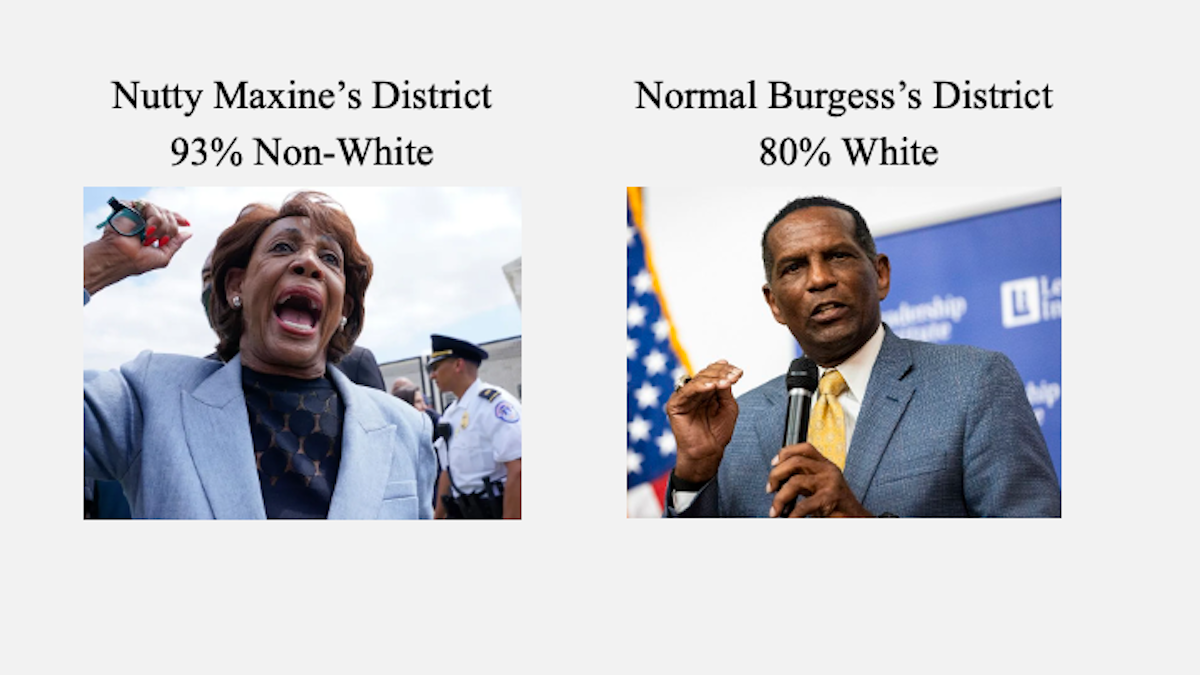
One, 71% of Americans self-selected “white” in the 2020 Census. Two, after 60 years of racial gerrymandering, 256 majority-white districts still remain. Three, nutty black congresswoman, Maxine Waters (D-CA), was elected eighteen times in a district that’s 93% non-white. Four, normal black congressman, Burgess Owens (R-UT), was elected three times in a district that’s 80% white. Five, normal black congressman, Byron Daniels (R-FL), was elected three times in a district that’s 75% white – and he’s currently favored to win Florida’s 2026 gubernatorial election (source: Stetson University polling).
This might seem mean, but aren’t 340 million Americans better off with more Burgess Owens and fewer Maxine Waters? Probably, and losing 19 “racially gerrymandered” districts by 2028 (the Cook Political Report’s estimate) is no big deal, because that would still leave 129 majority-minority districts. Sadly, that’s not good enough for the Democrat Party…because of this math: the GOP will pick up 30 “safe seats” in 2030 by virtue of erasing 19 racially-gerrymandered districts and 11 “net” migrations from blue to red states.
That’s why there is a mad dash to re-district before this year’s mid-term elections, to maximize “safe seats” by both parties. Still too early to predict a “blue wave” or “red hold” in November, but still the Supreme Court’s Louisiana v. Callais ruling is a big win for decent Americans who believe identity politics was killing their country.