
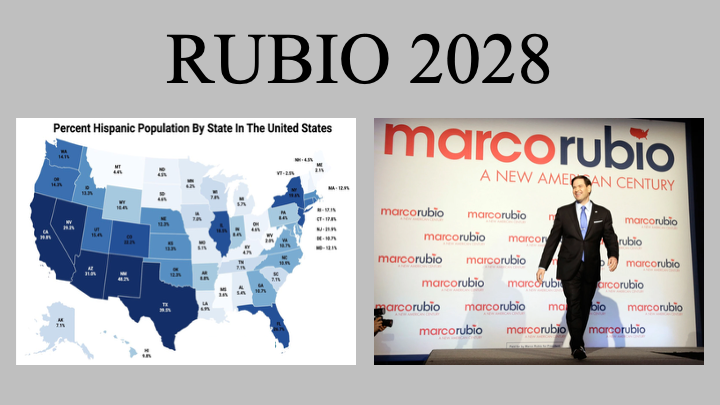
The Republican Party’s growing support among Hispanic voters is no accident. It reflects a deeper alignment on the issues that matter most. Hispanics are not interested in pandering or identity politics. They are focused on economic stability, safe communities, quality education, and a fair shot at success.
Jorge Martinez (former DOJ press secretary)
Seems like everybody’s asking about the mid-term elections; so, if I had to predict now – and it’s just a guess – Republicans will be lucky to hold onto the Senate. But that’s November, and I won’t trust the polls until voters see their tax refunds and know who the candidates are. That’s after Memorial Day, and what’s on my mind these days is 2028. Because that’s when the GOP has a generational opportunity to win an election that’s as transformational as the election of 1932.
1932: that’s when Franklin Roosevelt cobbled the New Deal Coalition out of four disparate groups (Blacks, Catholics, labor unions, and Southern whites), creating a dominant voting bloc that held for Democrats until Jimmy Carter’s ouster in 1980.
2028: that’s when Marco Rubio can forge the America First Coalition (Christians, Hispanics, married women, and whites) into a sustainable voting bloc that allows Republicans to undo the Democrat mess that’s killing our country.
Obama Was No Roosevelt
To appreciate the Republican opportunity one must understand the difference between FDR’s New Deal Coalition and Obama’s Coalition of the Ascendant, which is simply the difference between situational politics and identity politics. The New Deal was Roosevelt’s solution to a bad situation (25% unemployment and no government safety net) that was so widely felt he could unite groups as disparate as Blacks and southern whites. After winning only 40.9% of all votes in 1928, Democrats won 57.4% in 1932, plus 42 states and 472 electoral votes.
Four years later, the US electorate gave FDR a mandate with a tsunami – 46 states, 523 electoral votes, and 60.8% of the popular vote – that left Democrats sitting in 333 House seats and 76 Senate seats. The 1936 election was so transformational that Democrats held the presidency in 48 of 90 years thereafter, and both houses of Congress in 70 of 90 years. Which is why over 70% of today’s bureaucracy was created after 1936; including 9 of 15 executive departments (e.g. Education), 308 of 440 federal agencies (e.g. NASA), and 2,200 of 2,300 federal assistance programs (e.g. Medicaid).
FDR’s legacy stood the test of time; I’d argue that his coalition disintegrated only after voters knew Medicare and Social Security were untouchable. In contrast, Obama’s Coalition of the Ascendant (what political analyst Ron Brownstone called Obama’s minority, millennial, single-women, and college-educated voters) did not hold. In 2010, Democrats lost 63 House seats, 7 Senate seats, 20 state legislatures, and six gubernatorial seats in the mid-term elections. That political shift – the largest since 1948 – was invited by bad policies (DEI) and positions (single-payer health insurance). That failure led Democrats to identity politics (i.e. indulging “aggrieved” identities with 20-80 policies, like boys in girls sports) and decline.
Since 2008, Democrats have frittered away Obama’s coalition; down 15 points with minorities, 12 points with millennials, and 11 points with single women. Thanks to Trump, they did rise 3 points with college-educated voters. The table below quantifies Obama’s fleeting coalition by depicting its component shifts between 2008 and 2024.
| OBAMA’S COALITION OF THE ASCENDANT* | ||||
| VOTING BLOC | SHARE OF VOTE | 2008 | 2024 | CHANGE |
| MINORITIES | 29% | 80% | 65% | – 15 pts |
| MILLENNIALS | 30% | 66% | 54% | – 12 pts |
| SINGLE WOMEN | 26% | 70% | 59% | – 11 pts |
| COLLEGE EDUCATED | 43% | 53% | 56% | + 3 pts |
Don’t Sleep on America First
I trace the roots of America First populism to the “giant sucking sound” Ross Perot predicted in 1992. He did not win, and Bill Clinton signed NAFTA into law and admitted China into the WTO. Thus were born the “forgotten Americans” that turned against Bush Republicans and Clinton-Obama Democrats. Too much is made of Trump’s behavioral issues, but the man can identify a political party’s flaws and sell a competing idea. And that competing idea – that American ideals must be preserved – is what unites America First voters.
The view here is that the weakness of the Coalition of the Ascendant was cultural non-alignment (a black father in rural Virginia has almost nothing in common with single white woman in Palo Alto, California), while the strength of the America First Coalition is its cultural alignment (a Catholic Latino and a white Baptist share Christian values). And, while the Democrat coalition has weakened, the Republican coalition has strengthened. Two wit, the table below illustrates GOP constituent growth between 2008 and 2024; up 9 points with Cristians, 15 points with Hispanics, and 2 points with both married women and whites.
| TRUMP’S AMERICA FIRST COALITION* | ||||
| VOTING BLOC | SHARE OF VOTE | 2008 | 2024 | CHANGE |
| CHRISTIANS | 67% | 55% | 64% | + 9 pts |
| HISPANICS | 11% | 31% | 46% | + 15 pts |
| MARRIED WOMEN | 26% | 50% | 52% | + 2 pts |
| WHITES | 71% | 55% | 57% | + 2 pts |
The Case for Marco Rubio
Most polls now show J.D. Vance with a commanding lead for his party’s presidential nomination, but there is a lot of history, debates, and primary votes before he sits atop the Republican ticket. Not throwing shade on Vance, because the topic here is how a Rubio candidacy could do for Republicans in 2028 what Roosevelt did for Democrats in 1932. Because America First has a track record, Rubio should avoid the worst of Trump (e.g. mean tweets) and promise to continue what’s been working (e.g. jobs for native-born workers). And, as anyone in Florida can attest, Marco knows how to electioneer.
Rubio’s obvious strength should be his appeal to that 82% of the US electorate that is either Hispanic or white (source: 2024 exit polls). And, based on Florida’s 2020, 2022, and 2024 exit polls, there’s reason to suspect Rubio could outperform Trump with the America First Coalition (see table below):
| FLORIDA ELECTION RESULTS | ||||
| ELECTION | CHRISTIAN | HISPANIC | MARRIED WOMEN | WHITE |
| TRUMP 2020 | 58% | 46% | 46% | 62% |
| RUBIO 2022 | 64% | 56% | 53% | 64% |
| TRUMP 2024 | 56% | 58% | 51% | 63% |
Florida is a representative sample of the US electorate, because its population and economy are large, diverse, and growing (I’d argue it’s replaced California as the vanguard of where America’s headed). If the past is predictive of the future, Marco Rubio will win 80 million (61.6%) of 155 million ballots cast in 2028 by winning 62.9% of the Hispanic and white vote, which is 82% of the national (and 85% of Florida’s) popular vote. Further, that victory margin of 5 million votes does not even contemplate Rubio’s appeal to Christians and married women.
The numbers are compelling, but don’t adequately contrast the candidates. Rubio’s come a long way with Trump; from his support of MAGA policies in the Senate to his measured support for Trump’s 2020 election claims (accepted results, but expressed concern for election integrity), to his current role as (arguably) Trump’s best spokesman. Still, it’s how Rubio differs from Trump that makes him (arguably) more attractive to Republicans and Independents:
- 25 years younger
- More politesse
- Above “white supremacist” allegations
Rubio has no stronger qualification than his ability to excite Hispanic voters into becoming Republicans. I’ve seen Obama speak to a Black audience (2008) and Rubio speak to a Latino audience (2016) and it’s no contest. As Rubio toggled between English and Spanish, the crowd beamed with pride and roared its approval. That “pride” is what earned Kennedy 78% of the Catholic vote in 1960, and Obama 95% of the Black vote in 2008. If Rubio won just 60% of the Hispanic vote in 2028, he’d put the entire Sunbelt – including many congressional districts in California – into play, and turn every swing state into a red state.
Now…that’s an election I’d like to see. And if he won 75% of the Hispanic vote…that’s a future I’d like for my grandchildren.
[NOTE: * all data was sourced from AP VoteCast and NEP exit polls]