
Starting on Day one, we will end inflation and make American affordable again, to bring down the prices of all goods.
Candidate Trump (NBC News, August 2024)
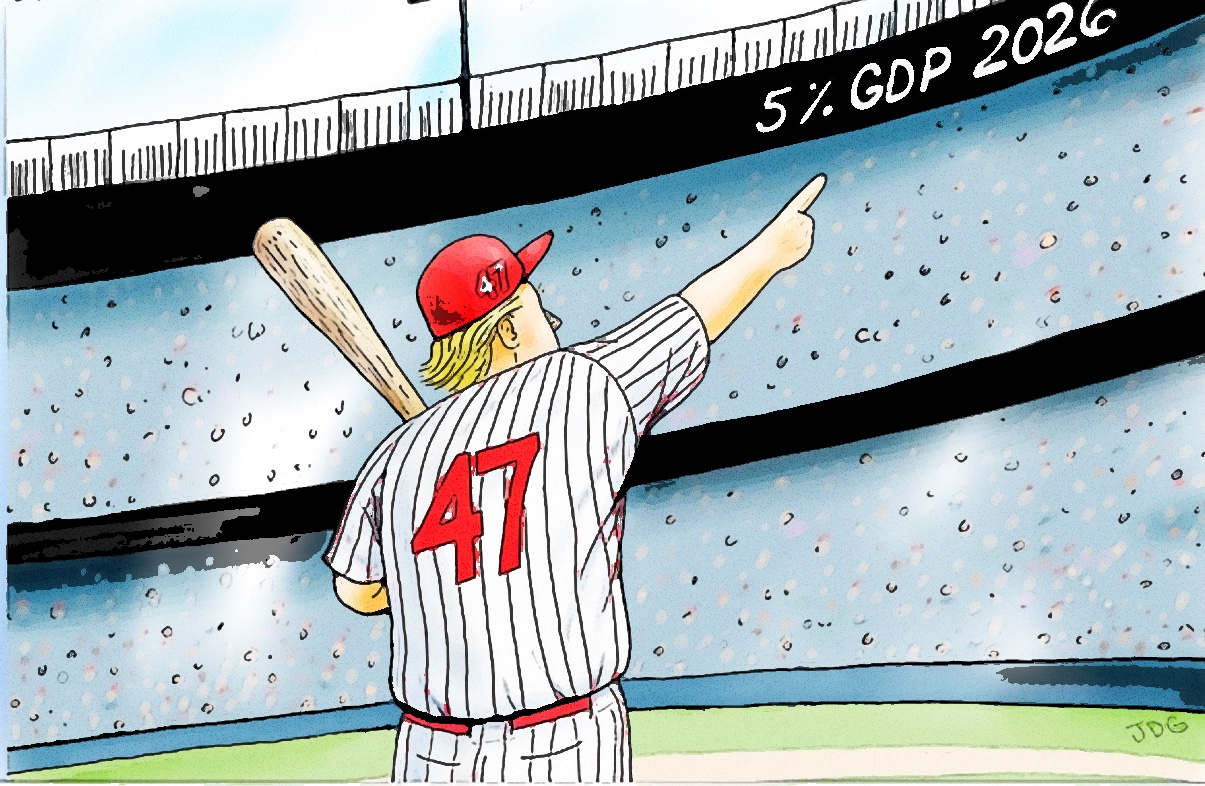
Success is biting off more than you can chew…and then chewing it…and that’s what the President’s trying to do after promising a quick fix to the economy. Not easy, when Democrats obstruct Trump’s policies and hostile media root against him. Disappointing – even conservatives admit that – because candidate Trump over-promised voters: “We will be slashing energy and electricity prices by half within 12 months…getting gasoline below $2.00 a gallon…cutting the cost of a new home in half…immediately bringing down grocery prices” (source: Trump campaign website).
Perhaps Trump was over-confident because of his first-term success; inheriting a GDP of $18.8 trillion from Obama and leaving a GDP of $23.7 trillion to Biden (source: Statista). Not bad, and his policies increased federal receipts from $3.2 trillion in 2016 to $4.1 trillion in 2021. Still, the US economy remains spotty with mid-term elections eleven months away, so the President went on TV Wednesday night to boast campaign that “inflation has stopped, wages are up, prices are down…we’re poised for an economic boom.”
His address was widely panned, but his prediction of an economic boom was legitimate, which is why the Treasury Secretary and Vice President re-directed reporters to 2026. They can do the math; when have cuts to interest rates, declining gas prices, fewer regulations, and less government spending not boosted the US economy? Thus, Trump’s problem is that he promised immediacy, his solutions have yet to take effect, and voters are disappointed; 55.5% disapprove of “his” economy (source: RCP polling average).
Typical of Trump, he expects nothing less than a Miracle on Main Street that will surprise and delight voters into retaining the current Republican majorities in Congress. He might be wrong, but he is actually trying to “make America great again” through extraordinary measures. Two stand out for their originality and potential.
Direct Foreign Investment – CBS News faulted the President for exaggerating (“$21 trillion”) how much Foreign Direct Investment (FDI) is flowing into the US, because $9.6 trillion is documented on the White House website. The “real news” is increased investment in the US; FDI of $102 billion in Q2-2025 was 137% higher than Q1-2025 (source: CNBC). That’s after FDI dropped under Biden; from $475 billion in 2021 to $206.3 billion in 2024. Fact: foreign companies ARE investing in the US economy, and this “good news” comes from the Wall Street Journal:
- TSMC (Taiwan): investing $165 billion in US, including five factories in Arizona
- AstraZeneca (UK): investing $50 billion in a new plant in Virginia and existing facilities in other states
- Roche/Genentech (Switzerland): investing $50 billion over five years in US manufacturing, including $550 million in Indiana
- Novartis (Switzerland): investing $23 billion to build or expand ten US manufacturing facilities
- Hyundai Motor Group (South Korea): investing $5.8 billion in a steel mill in Louisiana and $21 billion in other states
- Vantage Data Centers (Canada): investing $25 billion in a mega-scale data center in Texas
This foreign investment is good news because it’s contributing to “record CapEx spending” in 2025 (source: Reuters). This is “good news” because corporate capital expenditures are the leading edge of economic expansion. RKL LLC just estimated America’s 2025 CapEx spending will reach $3.4 trillion by year-end. That’s a staggering number, especially compared to Biden’s yearly average of $359 billion. So my question to the boo-birds at CBS is simple: why won’t “record CapEx spending” ignite an economic boom?
Trimming the Fat – The Trump administration has declared war on fat Americans. In August, the HHS Secretary granted waivers to twelve states allowing them to stop “junk foods” being bought with SNAP funds. In November, Trump announced deals with Eli Lilly and Novo Nordisk to slash the price of their obesity drugs (e.g. Ozempic) and expand their coverage. Making America healthy again (MAHA) may be the best economic idea to ever come out of Washington.
The U.S. has the highest rate (40%) of obesity prevalence in the G7, nearly 75% of our adults (20 and older) are overweight, and 20% of our young (ages 2 to 19) are obese (source: CDC). The economic impact is massive; the annual cost of obesity to the United States exceeds $1.4 trillion (source: The Milken Institute). The cost of fighting diabetes alone is $412.9 billion per year (source: American Diabetes Association). The macro-economic impact of MAHA could be huge, such as these two “less obesity” savings estimates:
- $260 billion saved annually by ending SNAP payments for junk foods (source: HHS)
- $170 billion in workplace savings (source: NAM)
Add MAHA to Trump’s Most Favored Nation drug-purchasing deals (14 of the 17 largest drug companies, resulting in 2026 savings of $6 billion to Medicare Part D and $14.1 billion to Medicaid) to get a greatly reduced budget deficit AND greatly increased disposable incomes. To estimate the boost to the US economy is to simply say you can’t count that high.
Those rooting against Trump probably don’t understand one paradigm of transformational change; it happens on the periphery. No question, Trump’s “fringe ideas” don’t come from the dominant system; the liberal institutions that control information and money. Which is why nobody saw this coming in 2025: the EU commitment to invest $600 billion in the US (on top of their “new” 15% tariff) and buy $750 billion is US energy exports. Now, why is that?
Because the “experts” inside the dominant system don’t prosper from fringe ideas, like asking Novartis to drop the price of Mayzent from $9,987 to $1,137 to help a million Americans suffering from Multiple Sclerosis. By the way, I scoured the liberal news outlets for editorials advocating most favored nation to reduce America’s healthcare costs, and found none until after Mr. Trump broke the news.
Trump’s mercurial nature makes me uneasy, but maybe that’s what the state of our union needs – so many ideas, one of them has to work – and that’s this president. Dislike the man, if you must, but don’t root against his solutions…because they just might work.
.